News
SpaceX details plan to build Mars Base Alpha with reusable Starship rockets

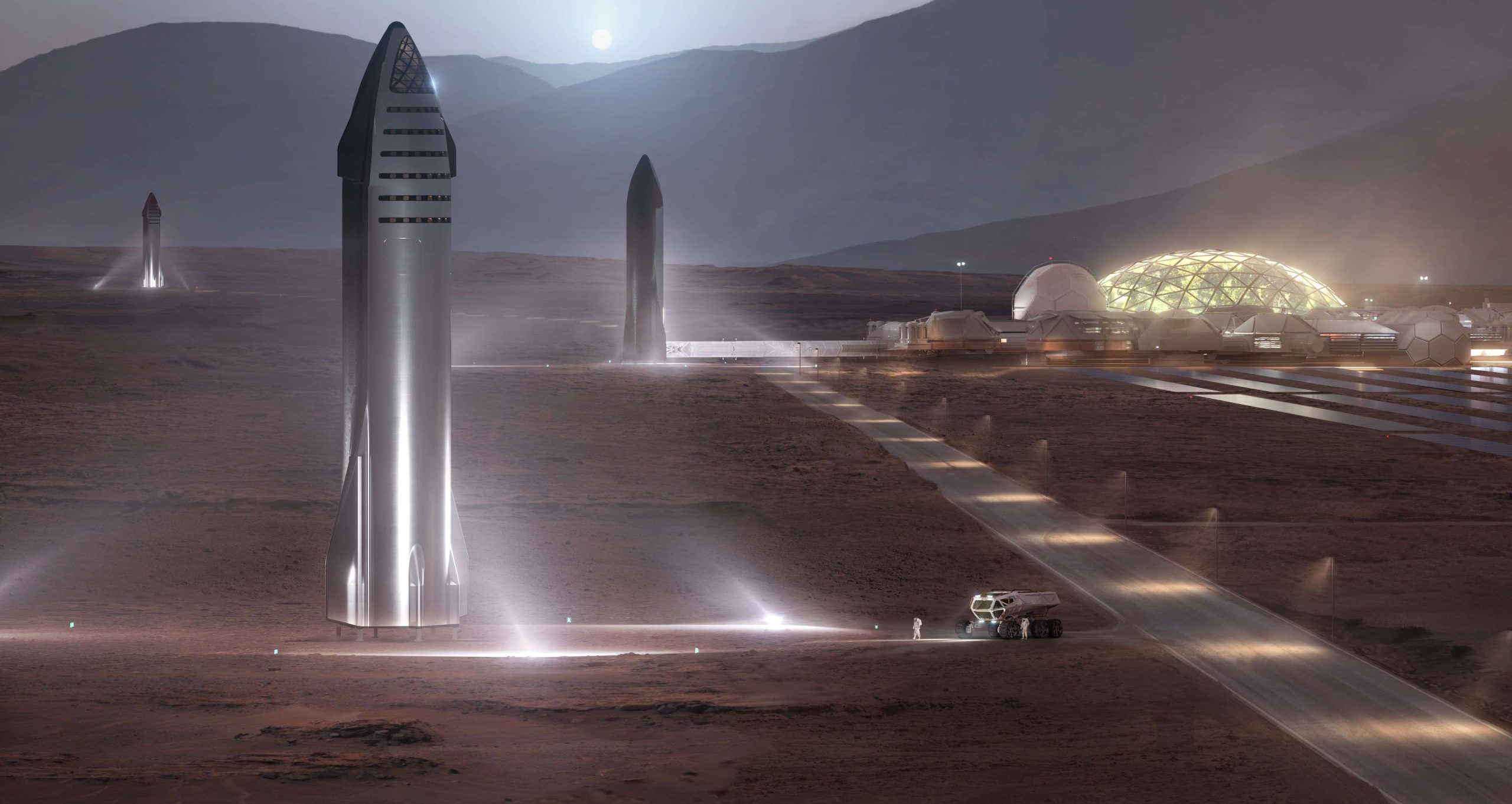
For the first time, SpaceX has teamed up with researchers from NASA and several other US institutions to publicly discuss how it plans to use Starship to build Mars Base Alpha.
Save for a handful of comments spread around the periphery of SpaceX and CEO Elon Musk’s main focus, Starship itself, the company and its executives have almost never specifically discussed how the next-generation fully-reusable rocket will be used to create a permanent human presence on Mars. For the most part, that clear focus on near-term hurdles is hard to fault. Half a century of mostly theoretical analysis has made it abundantly clear that a permanent and sustainable extraterrestrial human outpost is impossible without a radical reduction in the cost of access to space. For decades, NASA has studied and studied and studied slight variations of a plan that would cost hundreds of billions of dollars to send a few astronauts to Mars for a few months at a time.
Put simply, without a revolution in space transport, even a temporary presence on Mars where inhabitants are mostly dependent on imported goods is infeasible unless Mars exploration is made a national or international priority on the order of tens of billions of dollars per year. Over the 80-90 years that spaceflight has been seriously pondered, dozens of groups and papers and studies and space agencies have imagined what that revolution might look like and SpaceX is not unique for proposing a solution to that longstanding problem. However, SpaceX is the first of that long list of contenders to propose a solution and both invest significant resources and put hammer to metal in an attempt to make that vision real.
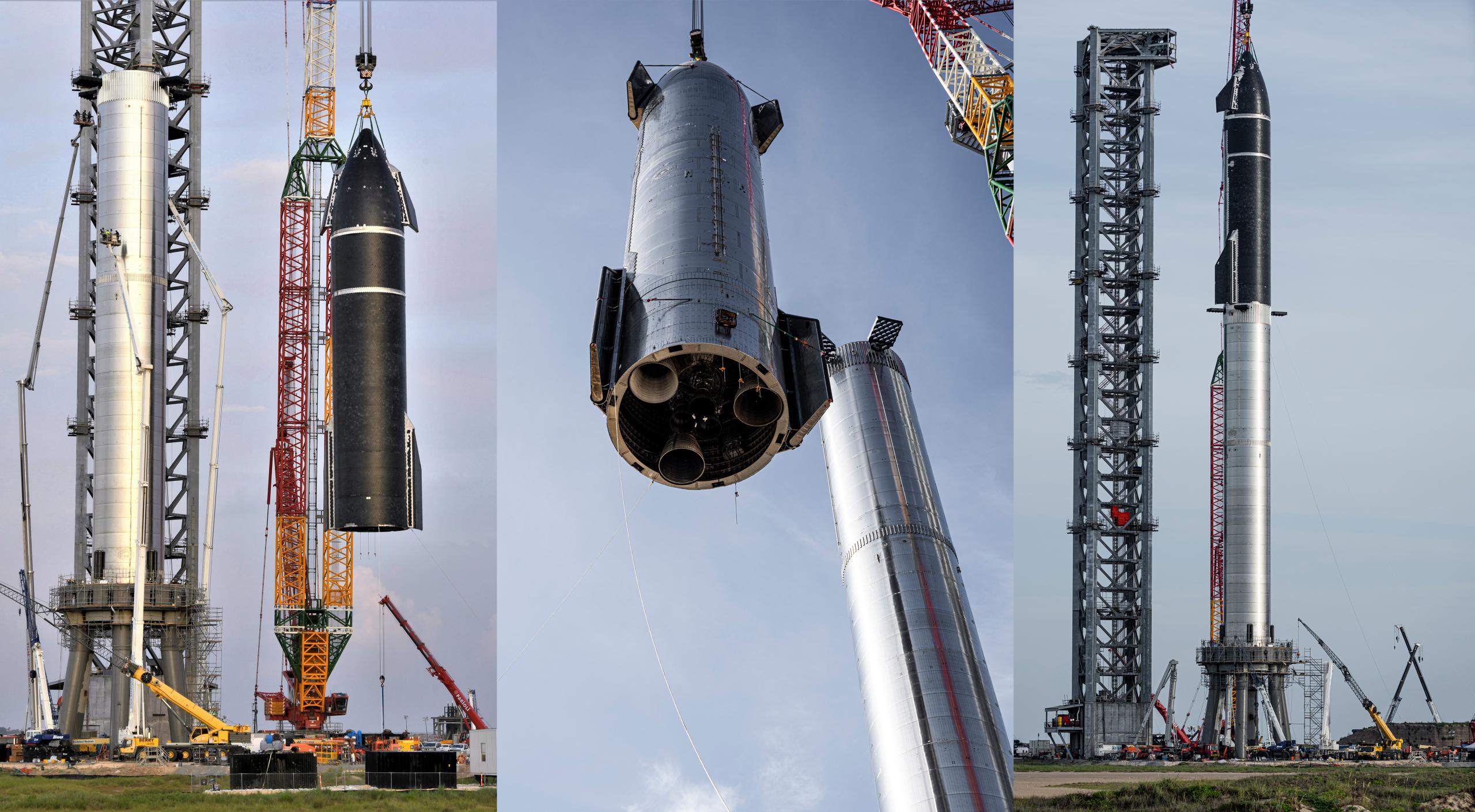
Two years after SpaceX announced its intention to build that next-generation space transportation system, Musk revealed a radical design change and work on the first steel Starship prototypes began. Three years later, SpaceX has completed nine Starship test flights – four brief hops and five flights above 10 km (6 mi). In 2021 alone, SpaceX completed four of those high-altitude flight tests, recovered a high-altitude prototype intact for the first time, built the first orbital-class ship and booster prototypes, began testing that ship, and is nearly finished the first orbital Starship launch site from scratch. In April, SpaceX also secured a $2.9 billion NASA contract to build a human-rated Moon lander variant of Starship.
Put simply, SpaceX – and now NASA with it – has laid a sturdy foundation upon which Starship will almost certainly be realized. A great deal of work remains but SpaceX has more or less surmounted most of the major technical hurdles that towered over Starship/BFR/ITS just a few years ago. A wealth of Starship ground and flight tests have firmly demonstrated that the rocket’s structures, avionics, Raptor engines, exotic methods of descent and landing, and previously unflown fuel of choice are all ready for orbital flight. From then on, SpaceX will still need to prove out Starship’s massive, ceramic, non-ablative heat shield technology; mature orbital rocket refueling techniques and technologies; and finally operationalize all the above to make the rapid launch, reuse, and refueling of the largest rocket in history routine and mundane – something SpaceX has proven to be more than capable of with Dragon and Falcon.
How, then, will SpaceX proceed to the Red Planet?
Packing for Mars
With the help of coauthors from NASA Ames, SETI, and half a dozen prestigious US universities and institutes, SpaceX has begun to answer exactly that question in a 2021 whitepaper [PDF] submitted for the National Academies’ next Planetary Science and Astrobiology Decadal Survey. While that survey alone could influence NASA as the agency prepares to outline its next decade of space science and determine the ultimate destination of tens of billions of federal dollars, the consequences of which could be immense, SpaceX also used the paper to describe its plans for early missions to Mars in unprecedented detail.
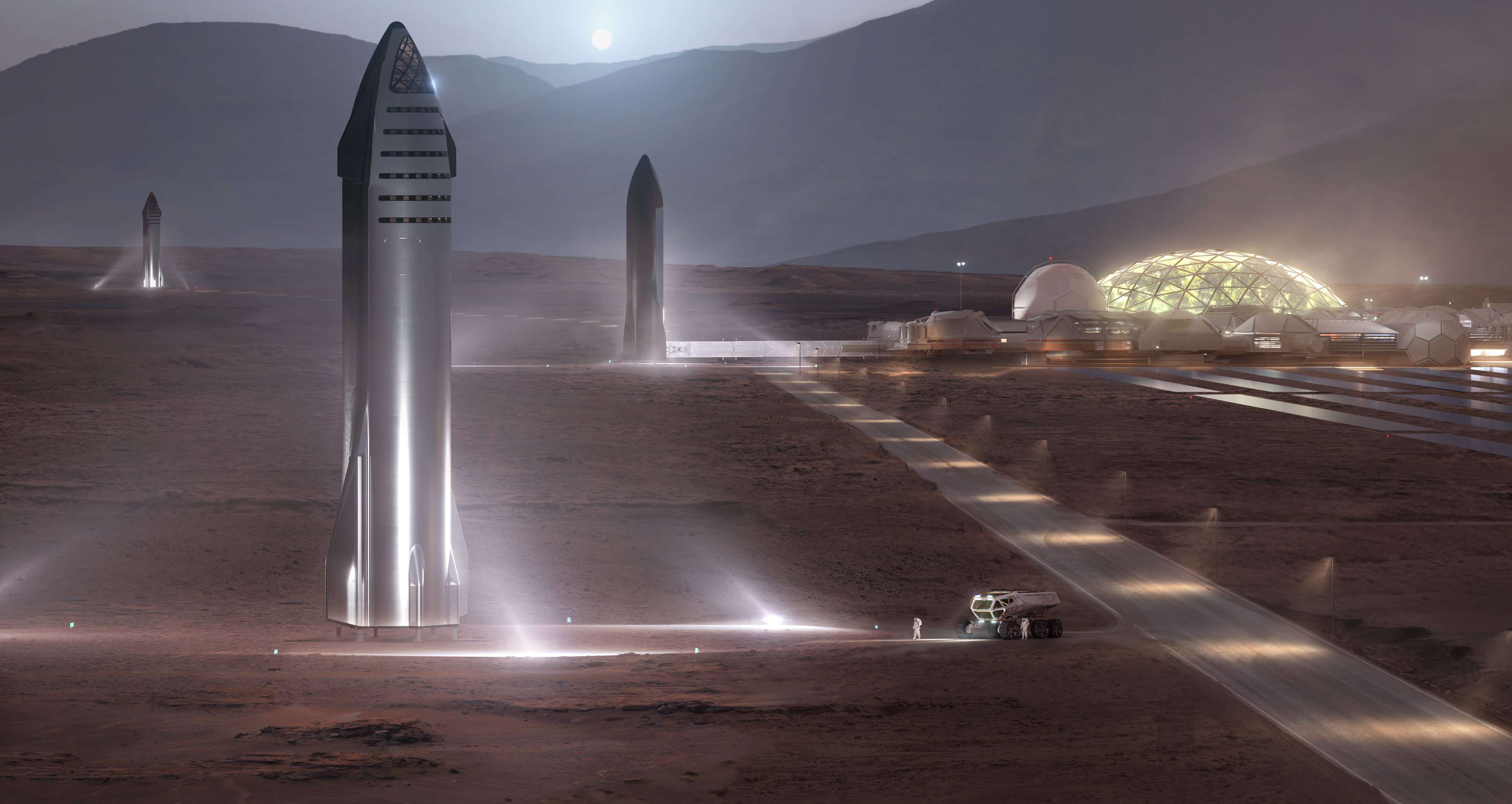
As has always been the plan, SpaceX will begin the process of constructing sustainable cities on Mars with a few (relatively) simple steps. Likely as soon as the mid-2020s, SpaceX will begin launching uncrewed Starships to Mars to both verify the system’s maturity and readiness and “deliver significant quantities of cargo to the surface in advance of human arrival.” Likely leaning on a wide range of robotics, those early missions will help SpaceX characterize local resources, stage supplies, test technologies for long-duration Martian surface ops, and begin developing infrastructure – with a propellant plant likely the most pressing need. None of that is surprising. However, there’s more.
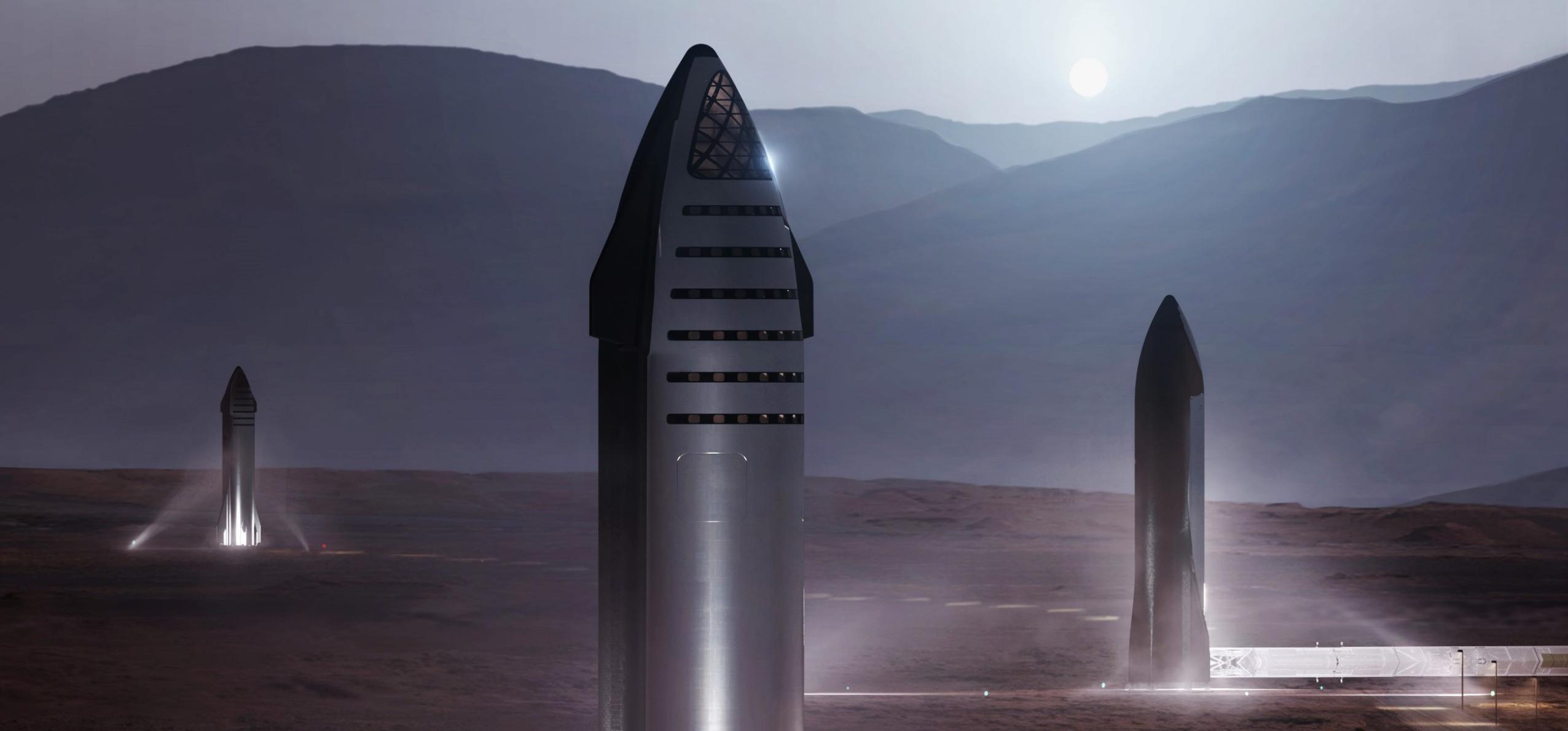
According to the authors, which include several current and former SpaceX engineers, “current SpaceX mission planning [tasks those early uncrewed Starships with delivering] equipment for increased power production, water extraction, LOX/methane production, pre-prepared landing pads, radiation shielding, dust control equipment, exterior shelters for humans and equipment, [and more – all hardware needed to support the first human base.]”
Further, confirming what’s been assumed to be the plan for years, “humans will likely live on [Starships] for the first few years until additional habitats are constructed” and “the first wave of uncrewed Starships can also be relocated and/or repurposed as needed to support the humans on the surface,” serving as “valuable assets for storage, habitation, [scientific laboratories], and a source of refined metal structures and resources.” The paper also states that “SpaceX is aggressively developing Starship to…conduct initial test flights to Mars…as soon as 2022 [or 2024]” and even raises the possibility of SpaceX launching the first Starship(s) to Mars before the rocket’s first lunar mission but then launching a separate lunar mission and landing a different Starship on the Moon while the Marsbound ship or ships are still in transit.
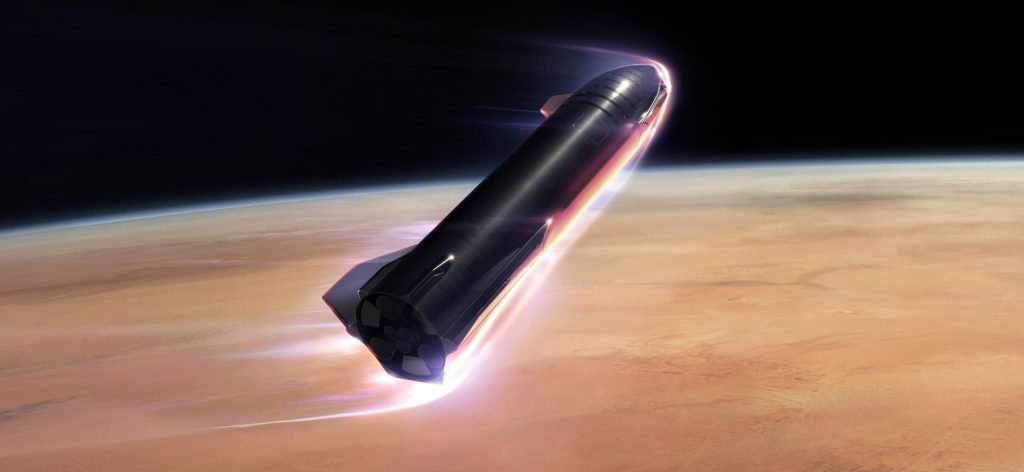
The whitepaper marks the first time that SpaceX (or those familiar with the company’s plans) has properly fleshed out the basics of its first crewed and uncrewed Starship missions to Mars and confirms a great deal of well-informed speculation. Namely, SpaceX appears to intend to pack even the very first Mars-bound ships with supplies. But even if they don’t bring much, the first Martian immigrants – launched in batches of “10-20 people” alongside “100+ metric tons” (~220,000+ lb) of cargo – will reuse all surviving Starships as pre-emplaced habitats, storage tanks, and raw material feedstock. Early cargo will focus on power, water, and propellant production, as well as shelters, radiation shielding, and the construction of prepared landing pads. Unsurprisngly, early residents will likely make the Starships that carry them to Mars their first homes on the surface of the Red Planet, taking advantage of an ~1100m³ (~39,000ft³) pressurized volume already outfitted to keep dozens of people alive and healthy in deep space for months at a time.


News
It’s official: SpaceX takes aim at Verizon, AT&T, and T-Mobile
SpaceX is buying 800 MHz spectrum from Grain to turn Starlink Mobile into a carrier.

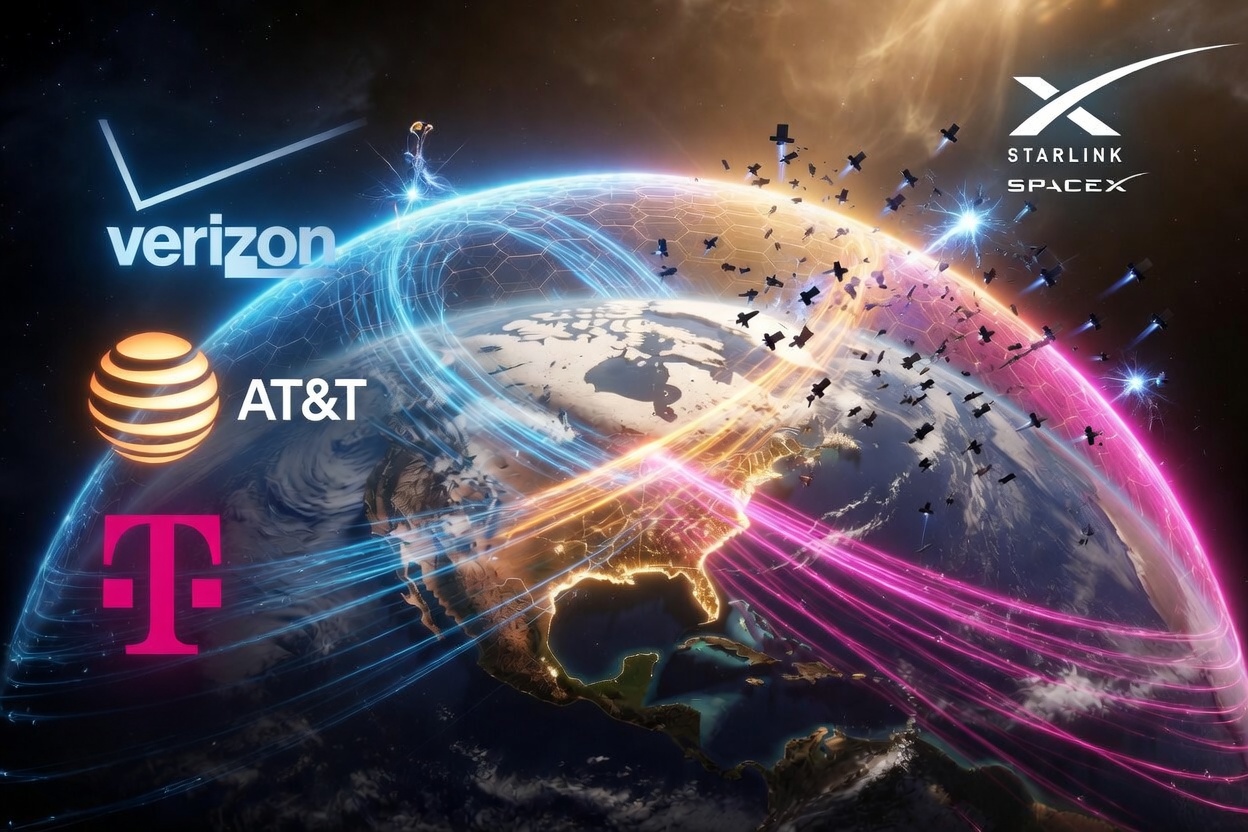
SpaceX has agreed to buy a nationwide block of low band wireless spectrum, a deal the company says will let Starlink Mobile operate as a full US carrier rather than a satellite add-on for someone else’s network.
The company announced the agreement on X on Thursday afternoon, saying it will “pave the way for @Starlink to become a major mobile carrier in the US.” The seller is Grain Management, a private investment firm that confirmed in a statement that SpaceX will acquire 100% of its nationwide 800 MHz portfolio. That covers up to 14 MHz of paired spectrum in the 817 to 824 MHz and 862 to 869 MHz bands. Neither side disclosed a price, and the deal still needs FCC approval.
We announced an agreement to acquire a nationwide low-band spectrum license portfolio that will pave the way for @Starlink to become a major mobile carrier in the US.
With this new spectrum and our Gen2 constellation, Starlink Mobile can ensure Americans have access to high-speed mobile broadband no matter where they are → https://t.co/1Uaf48v5pm
— SpaceX (@SpaceX) October 8, 2026
Grain only recently picked up the licenses itself. It bought the portfolio from T-Mobile in a transaction that closed in August, paying cash plus its own 600 MHz spectrum. Rival AST SpaceMobile had been testing satellites on the same bands before SpaceX stepped in.
SpaceX said its 2 GHz spectrum will handle high bandwidth capacity, while the new 800 MHz layer “ensures Starlink Mobile’s signal penetrates through obstacles, such as walls, and can provide service to customers’ devices even when they are in buildings.” The company added that most existing phones already support the band, so customers would not need new hardware to use it.
That 2 GHz spectrum came from SpaceX’s EchoStar acquisition last year, which gave the company exclusive S band rights in the US and global Mobile Satellite Service licenses. The Grain spectrum is different in an important way: it is tailored for service from ground towers, not satellites. SpaceX said that combination would make Starlink Mobile “the first network operator to deploy both satellite and terrestrial spectrum.”
The announcement also follows a key regulatory win. Earlier this week, the FCC approved SpaceX’s plan to deploy 15,000 second generation Starlink Mobile satellites, which the company has said will carry up to 100 times the data density of the current system, as Teslarati previously reported.
Shares of AT&T, Verizon and T-Mobile fell in extended trading after the announcement. T-Mobile is currently SpaceX’s launch partner for Starlink Mobile in the US, which makes its position the most complicated of the three.
SpaceX has not been subtle about its plans. During the company’s August earnings call, President and COO Gwynne Shotwell said she expected Starlink Mobile to win over customers from the major carriers. “I anticipate us to be able to acquire quite a few of their customers because I think our service will be better,” she said, pointing to dead zone coverage and resilience during disasters. Shotwell also described plans for low cost cellular base stations that could pair with existing Starlink dishes.
SpaceX has targeted 2027 for deployment of its next generation Starlink Mobile satellites, with upgraded service expected by the end of that year. The FCC review of the Grain deal now determines when the terrestrial half of that network can come online.
Elon Musk
Trump presents Elon Musk with National Medal of Science, calls him “modern-day Thomas Edison”
Trump gave Elon Musk the National Medal of Science and compared him to Thomas Edison.
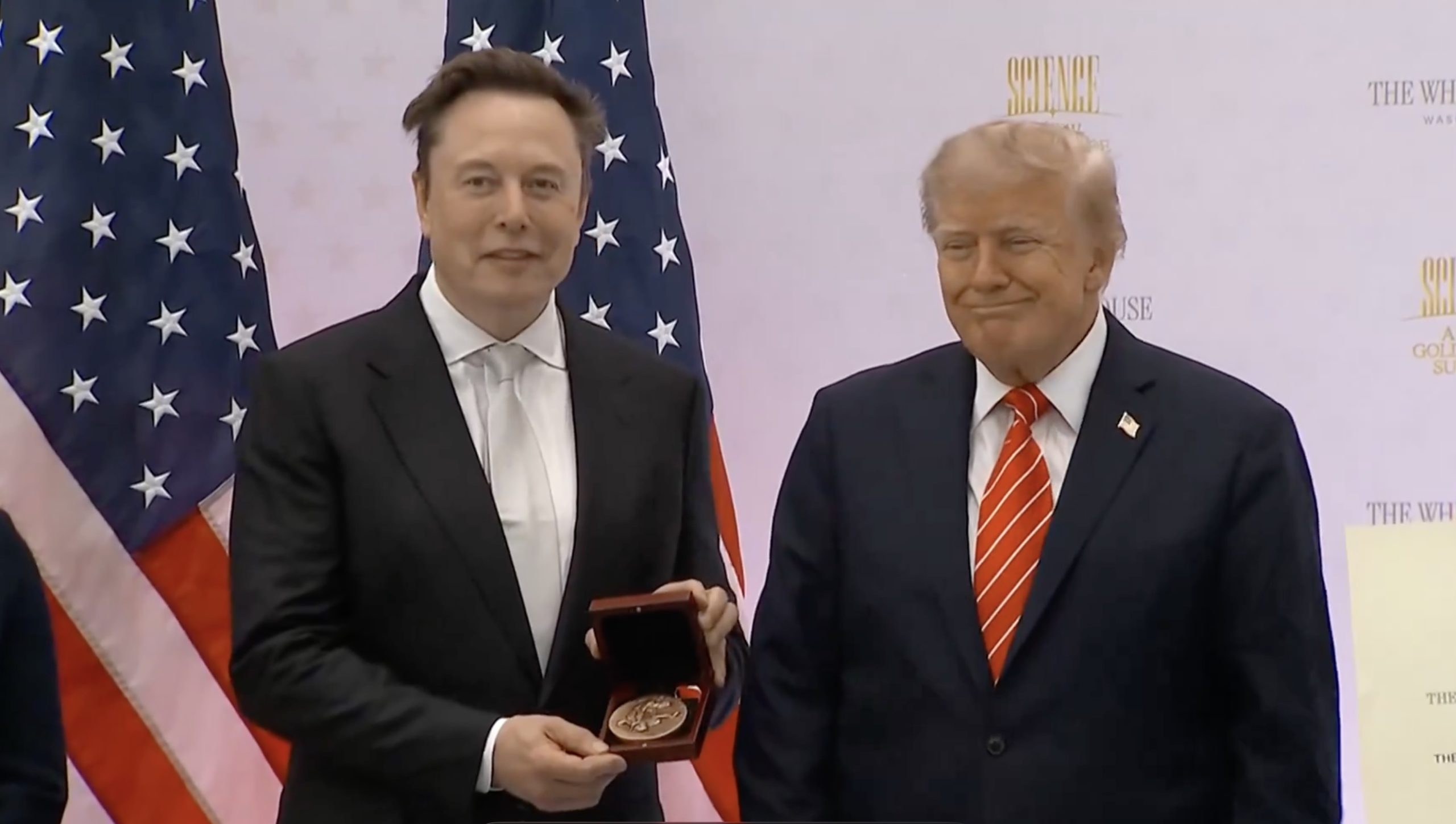
Elon Musk now has the highest honor the U.S. government gives to scientists and engineers. President Donald Trump presented him with the National Medal of Science on Thursday at the White House’s “Science: A New Golden Age” summit, held at the Institute of Peace in Washington, according to the White House.
Trump called Musk a “national treasure” and “our modern-day Thomas Edison.” “Few Americans in history have done more to advance America’s national interest than Elon in one field after another,” the president said. He also described Musk as an “industrial titan, brilliant engineer and one of the greatest technology founders to ever live.”
The official citation credits Musk “for engineering achievements of extraordinary ambition and scale that have pushed the frontiers of space exploration, intelligent systems, communications, and beyond, renewing American technological leadership and opening a new chapter in American manufacturing.” Tesla is not named in it, but “intelligent systems” and “American manufacturing” cover a lot of ground that Tesla and the Terafab chip project occupy.
Google co-founder Sergey Brin, Nvidia CEO Jensen Huang and AMD CEO Lisa Su received the same medal. Microsoft CEO Satya Nadella and Dell Technologies CEO Michael Dell were given the National Medal of Technology and Innovation. It was the first time Trump has handed out either award in his two terms. As Teslarati noted when the list was first reported on Wednesday, the National Science Foundation says 529 people have received the Medal of Science since Congress created it in 1959.
🚨 IT’S OFFICIAL: President Trump just PERSONALLY presented Elon Musk the National Medal of Science for his INCREDIBLE contributions to our nation
I can’t think of ANYONE who deserves this honor more 👏🏻
Congratulations, @elonmusk! https://t.co/GkAaVp9wb9
— Nick Sortor (@nicksortor) October 8, 2026
The ceremony closes a loop that opened in 2025, when Musk left DOGE and criticized the “Big Beautiful Bill,” sparking a public feud. Al Jazeera noted that Musk was the largest contributor to Trump’s 2024 campaign, and CNBC reported that all of the honorees have given financially to Trump or Republican causes in some form. The reconciliation has moved quickly in recent weeks. Musk sat at Trump’s left at the September 29 White House AI lunch, was named to help lead the Pentagon’s Project Meridian study on the future of warfare, and adopted the administration’s “super intelligence” wording when he said SpaceXAI will become SpaceXSI.
For Tesla and SpaceX shareholders, the practical question is what the closer relationship means for federal approvals. Tesla’s Robotaxi and Cybercab expansion depends on national autonomy rules, and SpaceX’s Starship and Starlink plans run through the FAA, FCC and NASA. Thursday’s ceremony did not change any of that directly.
Elon Musk
Elon Musk’s Boring Company lands a new Middle East deal, and Nashville is about to get faster
The Boring Company signs Abu Dhabi tunnel agreement while adding more Prufrock machines in Nashville.
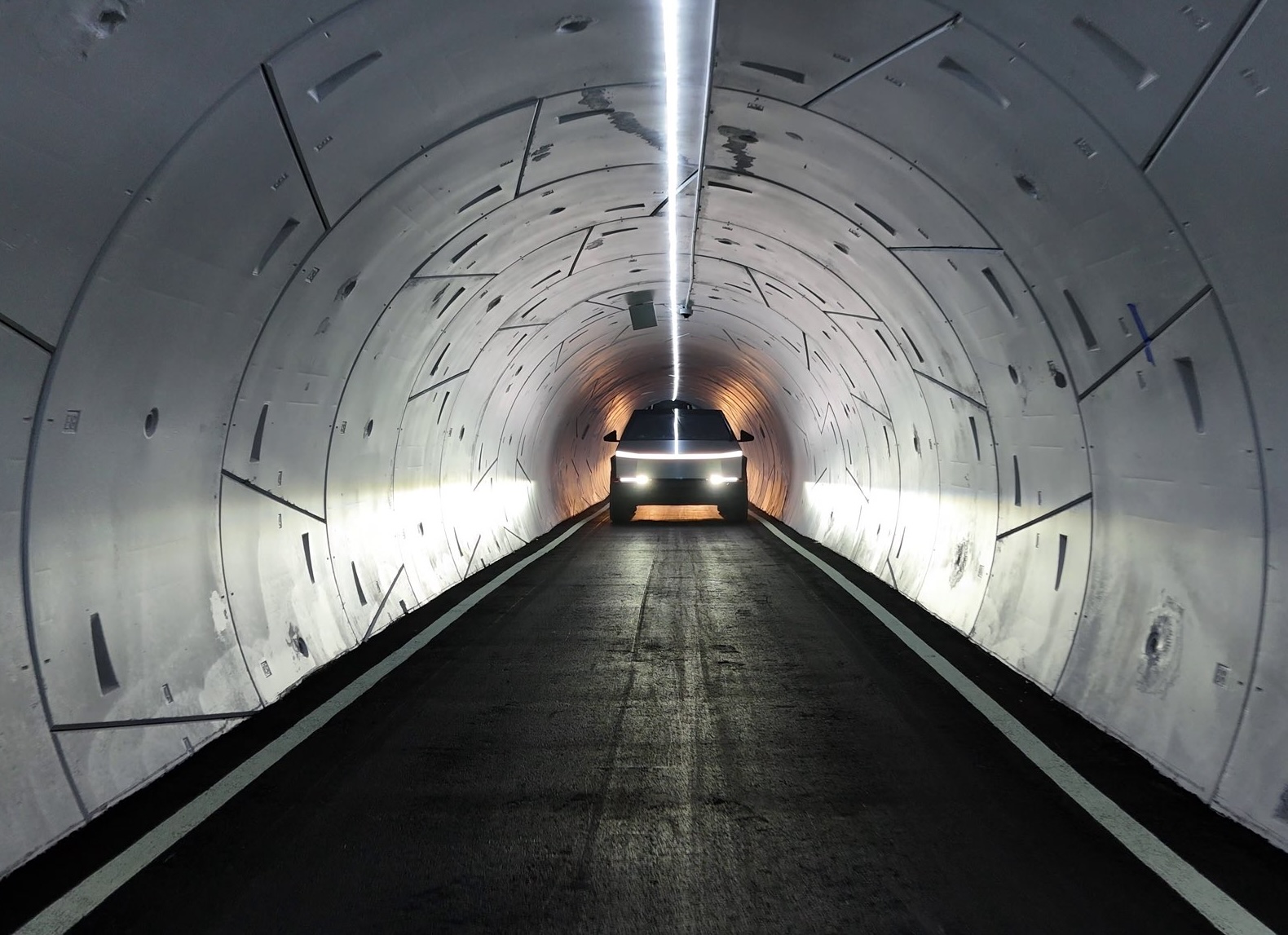
The Boring Company has signed an agreement with Abu Dhabi to study underground transport and utility tunnels across the emirate, adding a second UAE city to its pipeline as it prepares to also scale up tunneling back home in Nashville.
The deal was signed Thursday at the Liveability and Investment Exhibition (LIVEX 2026) by Boring Company President Steve Davis and Maysarah Mahmoud Salim Eid, director general of the Abu Dhabi Projects and Infrastructure Centre (ADPIC), according to the Abu Dhabi Media Office. Mohamed Ali Al Shorafa, chairman of the emirate’s Department of Municipalities and Transport, attended the signing.
Under the agreement, the two sides will assess feasibility, delivery and operating models for tunnels that could carry passengers or utilities. They will also look at Abu Dhabi’s potential as a regional hub for tunneling work. The current phase is exploratory, and no construction commitment or project budget has been announced.
“Abu Dhabi provides an ideal environment to explore the next generation of underground infrastructure solutions, supported by its ambitious growth vision and strong commitment to advanced technologies,”
Davis said. He added that the company wants to assess how tunnels can “expand urban capacity more efficiently, and enable better use of available space.”
The timing lines up with the money, considering last month, The Boring Company closed a $3 billion Series D led by the UAE and affiliated investors, valuing the company at $23 billion, as Teslarati reported. That round came with a commitment to build more than 150 kilometers of tunnel across the UAE, separate from the Dubai Loop pilot already under contract with Dubai’s Roads and Transport Authority. That pilot covers 6.4 kilometers and four stations linking DIFC and Dubai Mall at a cost of about $154 million.
Back home, The Boring Company projects in Nashville are also scaling up, with the company telling local NewsChannel 5 that a third Prufrock machine could start digging the Music City Loop in late October. A fourth is also targeted before the end of the year. Two machines are already mining Nashville limestone at the same time, and work is underway on a new launch site for the third.
The company said it has made more than 300 design and performance upgrades to its original Nashville machine. It is also working with property owners on more than 40 planned stations, with approvals in place for a future Nashville International Airport connection, a downtown station near the Music City Center, and stops at residential towers and the JW Marriott.
Construction on the Music City Loop began the same evening Tennessee and federal regulators approved the project’s lease in February, and the company targeted its first operational segment for late 2026. Back in Las Vegas, The Boring Company has said it plans to double its Vegas Loop station count by year’s end.

It’s official: SpaceX takes aim at Verizon, AT&T, and T-Mobile

Trump presents Elon Musk with National Medal of Science, calls him “modern-day Thomas Edison”

Elon Musk’s Boring Company lands a new Middle East deal, and Nashville is about to get faster

The Pentagon taps Elon Musk to design the battlefield of the future

Tesla Roadster’s new patent preps white-knuckle speeds, keeping it grounded


