SpaceX
SpaceX Falcon 9 rocket lands for the last time ahead of risky in-flight abort test

SpaceX’s latest successful launch and landing has wrapped up with Israeli Moon lander Beresheet on its way to Earth’s neighbor, Indonesian communications satellite PSN-6 headed to its final orbit, and the second thrice-flown Falcon 9 Block 5 booster safely returned to Port Canaveral aboard drone ship Of Course I Still Love You (OCISLY).
Known as Falcon 9 B1048, its third successful landing and recovery will almost certainly be this booster’s last after its fourth launch was officially assigned to a critical Crew Dragon launch abort test, one that the booster is very unlikely to survive. According to SpaceX CEO Elon Musk, that test could occur as early as April and will push the first flight-proven Crew Dragon space capsule to its limits.
https://twitter.com/_TomCross_/status/1099688043009753088
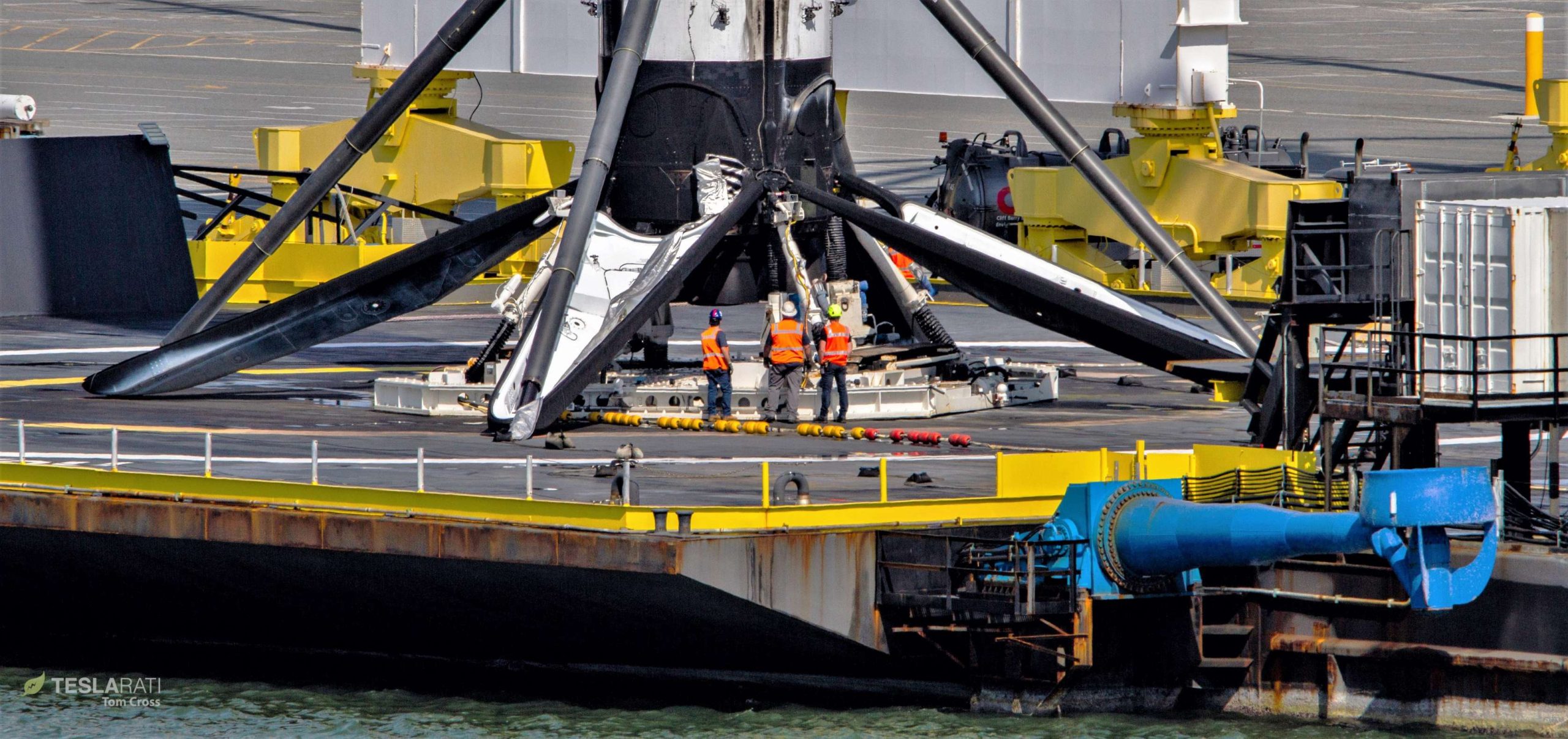
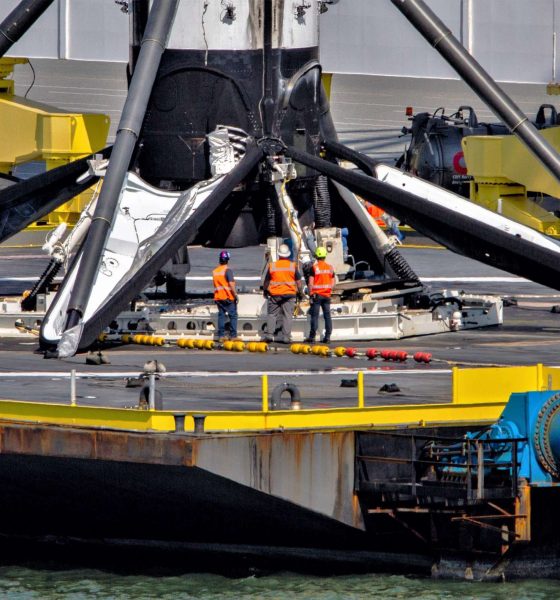
After weathering what Musk also described as the toughest reentry and heating conditions yet experience by a Falcon 9 booster meant for recovery, Falcon 9 B1048 landing (almost) flawlessly aboard drone ship OCISLY, stationed roughly 700 km (430 mi) off the Florida coast. Hinted at by the booster’s very slight lean on the recovery vessel’s deck, B1048 most likely cut thrust (or ran out of fuel) just before the optimal stop point, causing the rocket to fall a few unintended feet onto OCISLY and eat into part of the aluminum honeycomb ‘crush-core’ present on all Falcon landing legs.
Reentry, even at 1/4 of orbital speed is hard pic.twitter.com/Tk2KJblWH5
— Scott Manley (@DJSnM) February 22, 2019
In essence, that crushable aluminum acts as a very rough form of emergency suspension meant to minimize potential damage to the fragile structure of Falcon booster propellant tanks at the cost of its landing legs. In the case of B1048’s third landing, the lean appears to be no more than a few degrees – scarcely out of the ordinary, at least relative to past leaning boosters. Most notably, Falcon 9 B1023 experienced a similar anomaly and a far worse lean after its first landing, an experience that did not apparently impact its ability to launch for the second time as a side booster for Falcon Heavy’s inaugural launch.
-
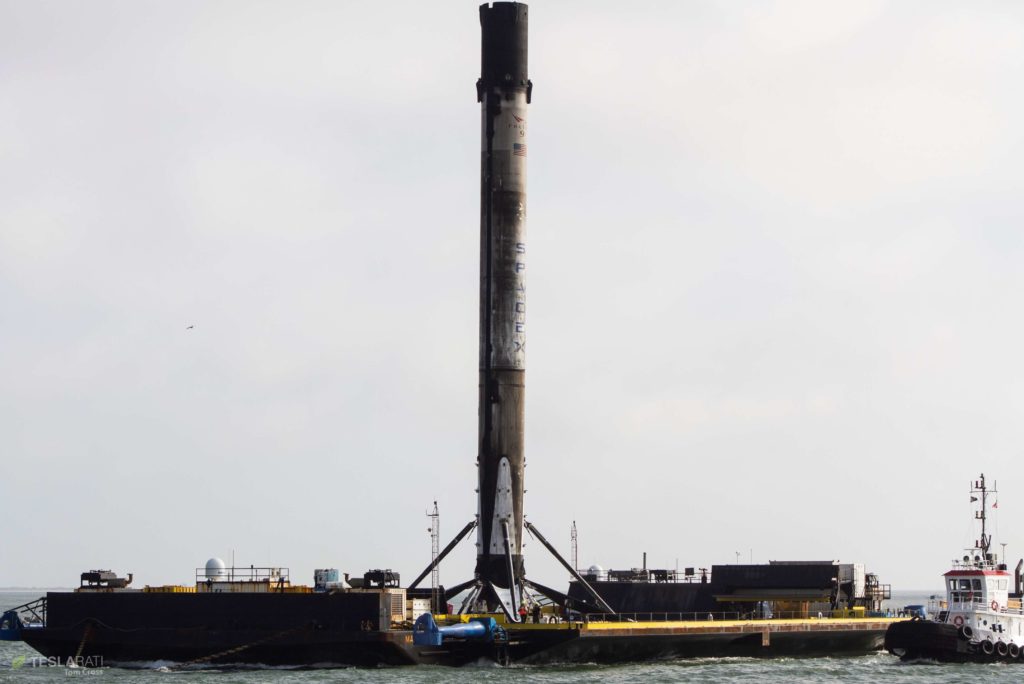
- Falcon 9 B1048 returned to Port Canaveral on February 24th after its third successful launch and landing. (Teslarati)
-
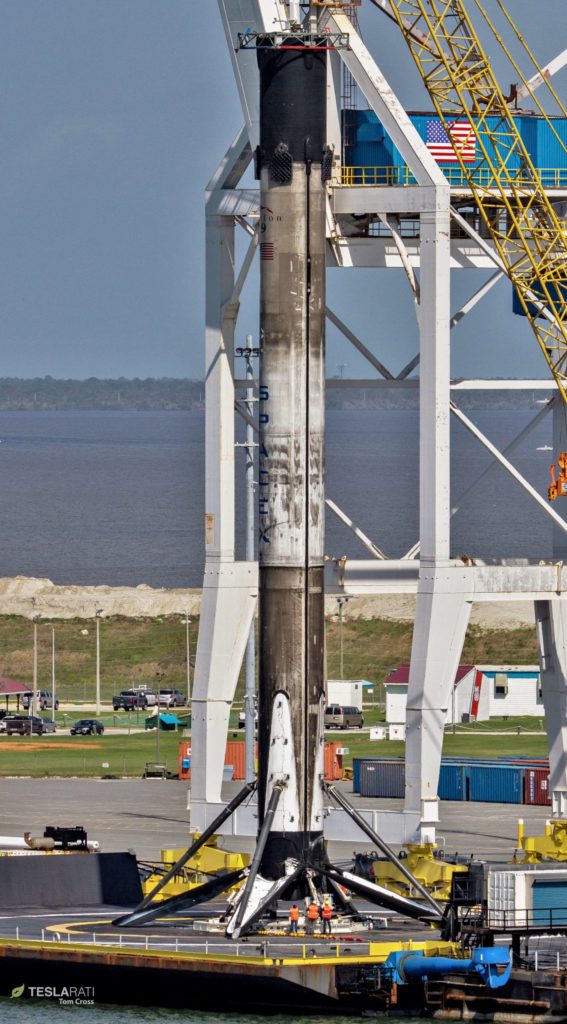
- B1048.3 beside its human caretakers. (Tom Cross)
-
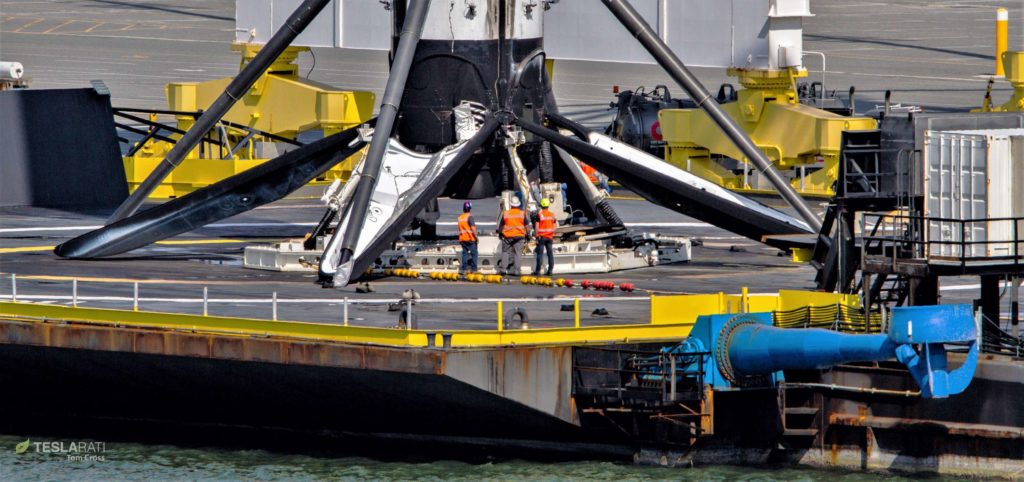
- Octagrabber robots are meant to prevent boosters from sliding off of drone ship decks by anchoring them with their tank-like weight. (Teslarati)
B1048’s slight departure from a perfect trajectory should thus pose no problem for in-place plans for the rocket’s fourth (and likely final) launch. Known as Crew Dragon’s in-flight abort (IFA) test, SpaceX specifically requested the inclusion of a second abort test (above and beyond NASA’s testing requirements) to fully verify that astronauts could be pulled to safety at any point during launch. In 2015, the company completed a pad abort test of Crew Dragon, demonstrating that the spacecraft could escape from a failing rocket while static on the launch pad. The in-flight abort is precisely what it sounds like: a demonstration that Crew Dragon can safely escape a failing rocket while in flight. More than simply being in flight, the goal is to demonstrate a successful abort at the point of peak aerodynamic stress of Falcon 9 and Dragon, known as Max Q.
For Cargo Dragon launches, Falcon 9 has typically averaged dynamic forces of about 25 kPa (~4 psi), roughly equivalent to 2.5 tons of force per square meter. During launch, either the payload fairing or Cargo/Crew Dragon are subjected directly to those forces, often requiring a significant period of lower throttle to mitigate the forces those sensitive assemblies experience. Given that Crew Dragon’s abort scenario accelerates the capsule and trunk from a relative speed of zero to nearly 350 mph (150 m/s) in five seconds, the dynamic forces (i.e. mechanical loads and heating) the spacecraft is experiencing could jump 50% or more almost instantaneously.
-
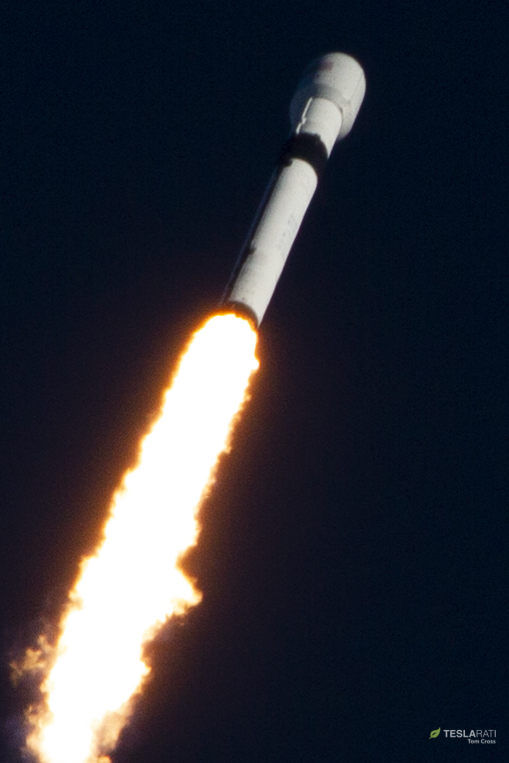
- Falcon 9 B1054 around the time of Max Q. (Tom Cross)
-
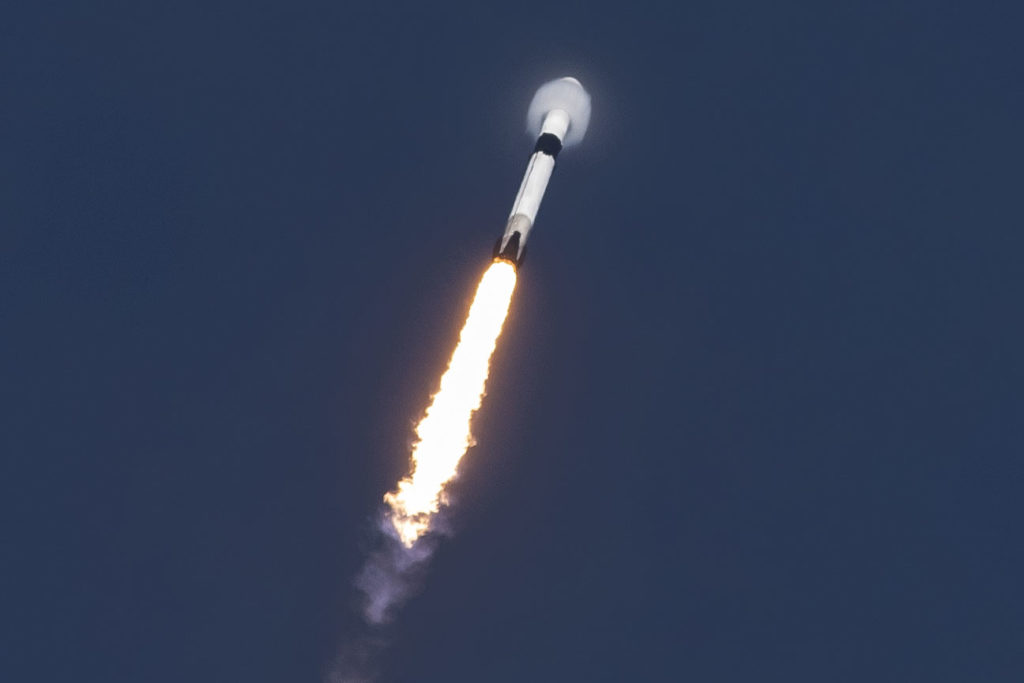
- While it doesn’t necessarily correlate with Max Q, vapor cones like the one on B1047’s fairing are a partial visualization of Max Q forces. (SpaceX)
-
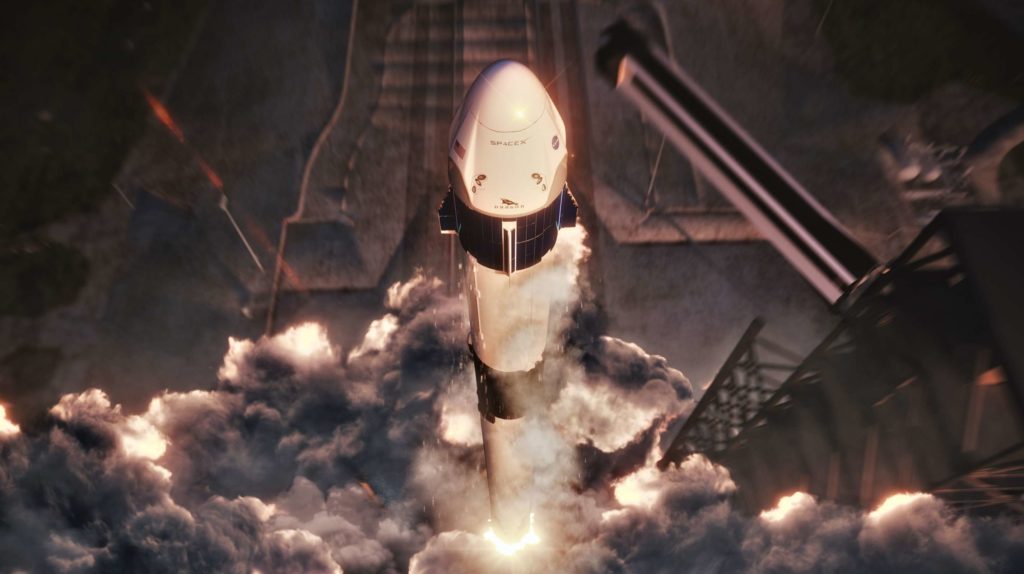
- An official SpaceX render shows Falcon 9 and Crew Dragon lifting off from Pad 39A. (SpaceX)
-
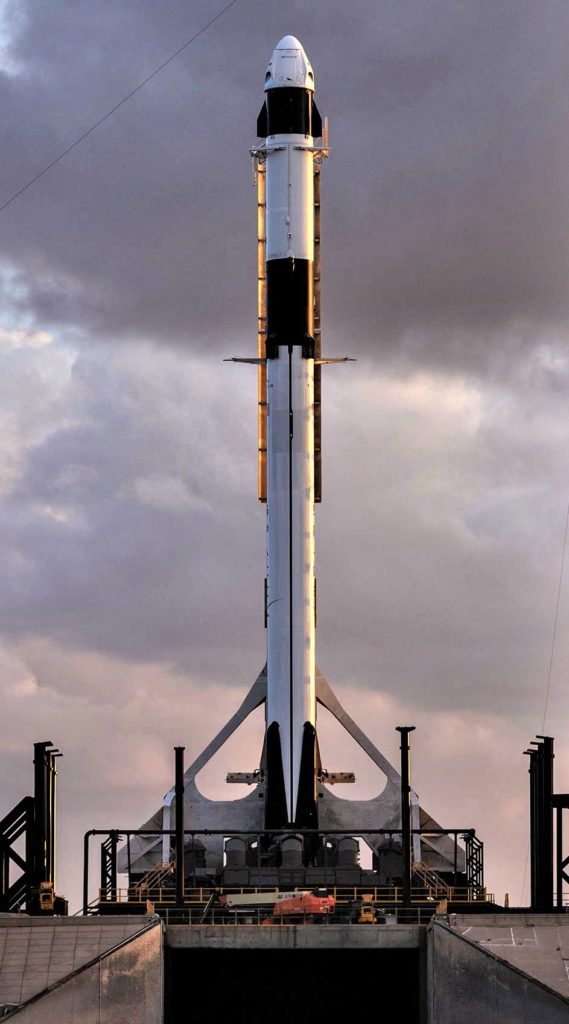
- Falcon 9 B1051 and Crew Dragon vertical at Pad 39A. (SpaceX)
After Crew Dragon aborts, the Falcon 9 stack – featuring B1048 and a full-fidelity upper stage with a mass simulator in place of its MVac engine – will be instantaneously exposed to those same dynamic forces, experientially equivalent to bellyflopping from an Olympic-height diving platform. The upper stage may actually be better off than the booster thanks to the generally smooth dome at its stern, whereas Falcon 9’s booster would have its interstage – a deep, open cylinder – exposed to the same airflow if or when the upper stage is torn away. At the point of abort, Falcon 9 will most likely be in the process of shutting down its Merlin 1D engines, effectively removing the booster’s control authority and leaving it at the mercy of the atmosphere. SpaceX’s CRS-7 Cargo Dragon failure (caused by the second stage losing structural integrity mid-flight) is actually a decent representation of what is likely to happen to B1048 and its upper stage.
Given the potential destructive power B1048 will face, not to mention the fact that the booster will likely not have grid fins or landing legs installed, today’s recovery will probably be the last time the rocket returns to port and prepares for another launch. Explicitly dependent upon the refurbishment of DM-1’s Crew Dragon capsule, SpaceX’s in-flight abort is not expected to occur until June 2019, although Musk has indicated that the aspirational target is to perform the test as early as April, perhaps less than 60 days after the capsule is scheduled to land in the Atlantic Ocean.
Check out Teslarati’s newsletters for prompt updates, on-the-ground perspectives, and unique glimpses of SpaceX’s rocket launch and recovery processes!


Investor's Corner
SpaceX IPO is coming, CEO Elon Musk confirms
However, it appears Musk is ready for SpaceX to go public, as Ars Technica Senior Space Editor Eric Berger wrote an op-ed that indicated he thought SpaceX would go public soon. Musk replied, basically confirming it.

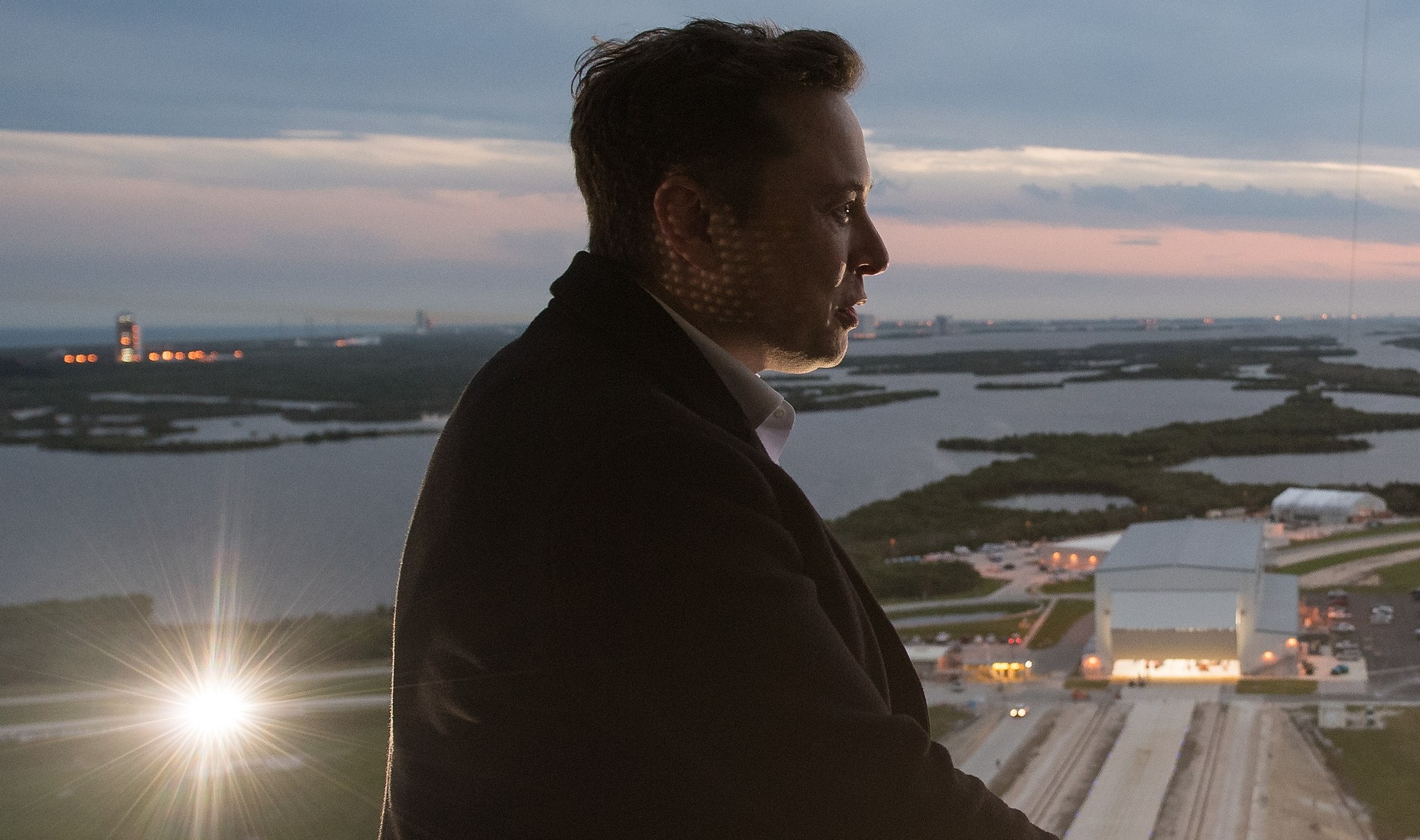
Elon Musk confirmed through a post on X that a SpaceX initial public offering (IPO) is on the way after hinting at it several times earlier this year.
It also comes one day after Bloomberg reported that SpaceX was aiming for a valuation of $1.5 trillion, adding that it wanted to raise $30 billion.
Musk has been transparent for most of the year that he wanted to try to figure out a way to get Tesla shareholders to invest in SpaceX, giving them access to the stock.
He has also recognized the issues of having a public stock, like litigation exposure, quarterly reporting pressures, and other inconveniences.
However, it appears Musk is ready for SpaceX to go public, as Ars Technica Senior Space Editor Eric Berger wrote an op-ed that indicated he thought SpaceX would go public soon.
Musk replied, basically confirming it:
As usual, Eric is accurate
— Elon Musk (@elonmusk) December 10, 2025
Berger believes the IPO would help support the need for $30 billion or more in capital needed to fund AI integration projects, such as space-based data centers and lunar satellite factories. Musk confirmed recently that SpaceX “will be doing” data centers in orbit.
AI appears to be a “key part” of SpaceX getting to Musk, Berger also wrote. When writing about whether or not Optimus is a viable project and product for the company, he says that none of that matters. Musk thinks it is, and that’s all that matters.
It seems like Musk has certainly mulled something this big for a very long time, and the idea of taking SpaceX public is not just likely; it is necessary for the company to get to Mars.
The details of when SpaceX will finally hit that public status are not known. Many of the reports that came out over the past few days indicate it would happen in 2026, so sooner rather than later.
But there are a lot of things on Musk’s plate early next year, especially with Cybercab production, the potential launch of Unsupervised Full Self-Driving, and the Roadster unveiling, all planned for Q1.
News
SpaceX reportedly mulling IPO, eyeing largest of all time: report
“I do want to try to figure out some way for Tesla shareholders to participate in SpaceX. I’ve been giving a lot of thought to how to give people access to SpaceX stock,” Musk said.
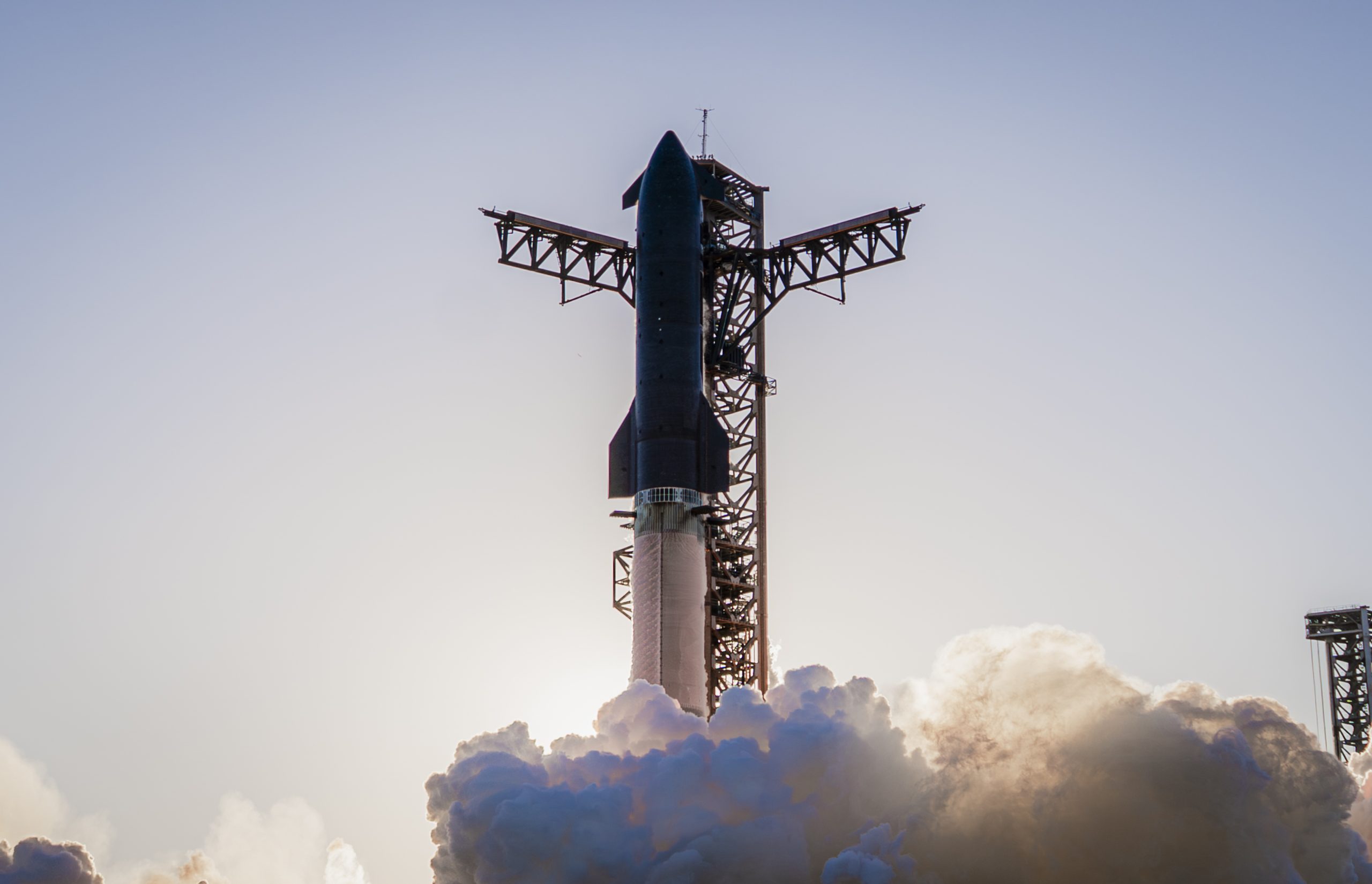
SpaceX is reportedly mulling an initial public offering, eyeing what would be the largest valuation at the time of availability of all time, a new report from Bloomberg said on Tuesday.
It is one of many reports involving one of Elon Musk’s companies and a massive market move, as this is not the first time we have seen reports of an IPO by SpaceX. Musk himself has also dispelled other reports in the past of a similar nature, including an xAI funding round.
SpaceX and Musk have yet to comment on the report. In the past, untrue reports were promptly replied to by the CEO; this has not yet gained any response, which is a good sign in terms of credibility.
However, he said just a few days ago that stories of this nature are inaccurate:
“There has been a lot of press claiming SpaceX is raising money at $800B, which is not accurate. SpaceX has been cash flow positive for many years and does periodic stock buybacks twice a year to provide liquidity for employees and investors. Valuation increments are a function of progress with Starship and Starlink and securing global direct-to-cell spectrum that greatly increases our addressable market. And one other thing that is arguably most significant by far.”
There has been a lot of press claiming @SpaceX is raising money at $800B, which is not accurate.
SpaceX has been cash flow positive for many years and does periodic stock buybacks twice a year to provide liquidity for employees and investors.
Valuation increments are a…
— Elon Musk (@elonmusk) December 6, 2025
Musk has discussed a potential IPO for SpaceX in recent months, as the November 6 shareholder meeting, as he commented on the “downsides” of having a public company, like litigation exposure, quarterly reporting pressures, and other inconveniences.
Nevertheless, Musk has also said he wants there to be a way for Tesla shareholders to get in on the action. At the meeting in early November, he said:
“I do want to try to figure out some way for Tesla shareholders to participate in SpaceX. I’ve been giving a lot of thought to how to give people access to SpaceX stock.”
Additionally, he added:
“Maybe at some point., SpaceX should become a public company despite all the downsides of being public.”
Musk has been historically reluctant to take SpaceX public, at times stating it could become a barrier to colonizing Mars. That does not mean it will not happen.
Bloomberg’s report cites multiple unidentified sources who are familiar with the matter. They indicate to the publication that SpaceX wants to go public in mid-to-late 2026, and it wants to raise $30 billion at a valuation of around $1.5 trillion.
This is not the first time SpaceX has discussed an IPO; we reported on it nine years ago. We hope it is true, as the community has spoken for a long time about having access to SpaceX stock. Legendary investor Ron Baron is one of the lucky few to be a SpaceX investor, and said it, along with Tesla, is a “lifetime investment.”
Tesla bull Ron Baron reveals $100M SpaceX investment, sees 3-5x return on TSLA
The primary driver of SpaceX’s value is Starlink, the company’s satellite internet service. Starlink contributes 60-70 percent of SpaceX’s revenue, meaning it is the primary value engine. Launch services, like Falcon 9 contracts, and the development of Starship, also play supporting roles.
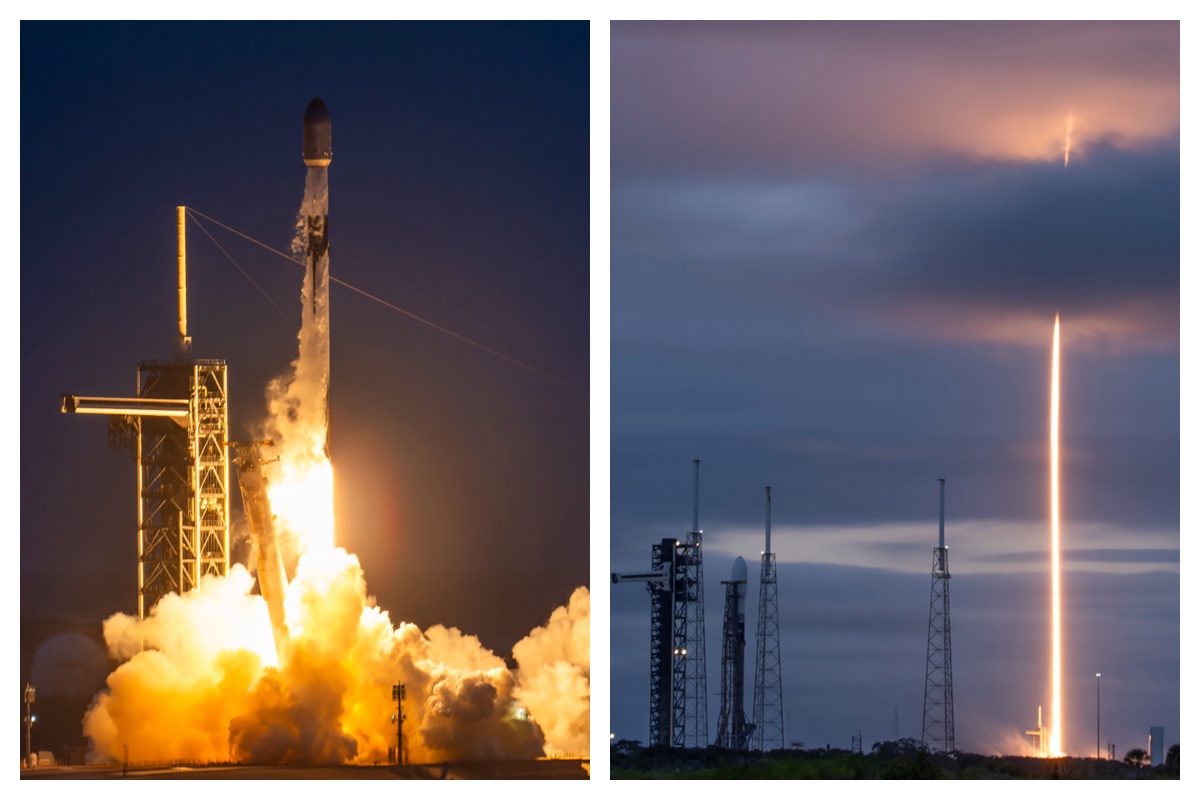
SpaceX reached an incredible milestone with its Starlink program with a launch last night, as the 3,000th satellite of the year was launched into low Earth orbit.
On Monday, SpaceX also achieved its 32nd flight with a single Falcon 9 rocket from NASA’s Kennedy Space Center.
The mission was Starlink 6-92, and it utilized the Falcon 9 B1067 for the 32nd time this year, the most-used Falcon booster. The flight delivered SpaceX’s 3000th Starlink satellite of the year, a massive achievement.
There were 29 Starlink satellites launched and deployed into LEO during this particular mission:
Falcon 9 launches 29 @Starlink satellites from Florida pic.twitter.com/utKrXjHzPN
— SpaceX (@SpaceX) December 9, 2025
SpaceX has a current goal of certifying its Falcon boosters for 40 missions apiece, according to Spaceflight Now.
The flight was the 350th orbital launch from the nearby SLC-40, and the 3,000 satellites that have been successfully launched this year continue to contribute to the company’s goal of having 12,000 satellites contributing to global internet coverage.
There are over five million users of Starlink, the latest data shows.
Following the launch and stage separation, the Falcon 9 booster completed its mission with a perfect landing on the ‘Just Read the Instructions’ droneship.
The mission was the 575th overall Falcon 9 launch, highlighting SpaceX’s operational tempo, which continues to be accelerated. The company averages two missions per week, and underscores CEO Elon Musk’s vision of a multi-planetary future, where reliable connectivity is crucial for remote work, education, and emergency response.
As Starlink expands and works toward that elusive and crucial 12,000 satellite goal, missions like 6-92 pave the way for innovations in telecommunications and enable more internet access to people across the globe.
With regulatory approvals in over 100 countries and millions of current subscribers, SpaceX continues to democratize space, proving that reusability is not just feasible, but it’s also revolutionary.

Tesla updates Cybertruck owners about key Powershare feature

Tesla’s northernmost Supercharger in North America opens


