Elon Musk
Elon Musk takes latest barb at Bill Gates over Tesla short position
Bill Gates placed a massive short bet against Tesla of ~1% of our total shares, which might have cost him over $10B by now

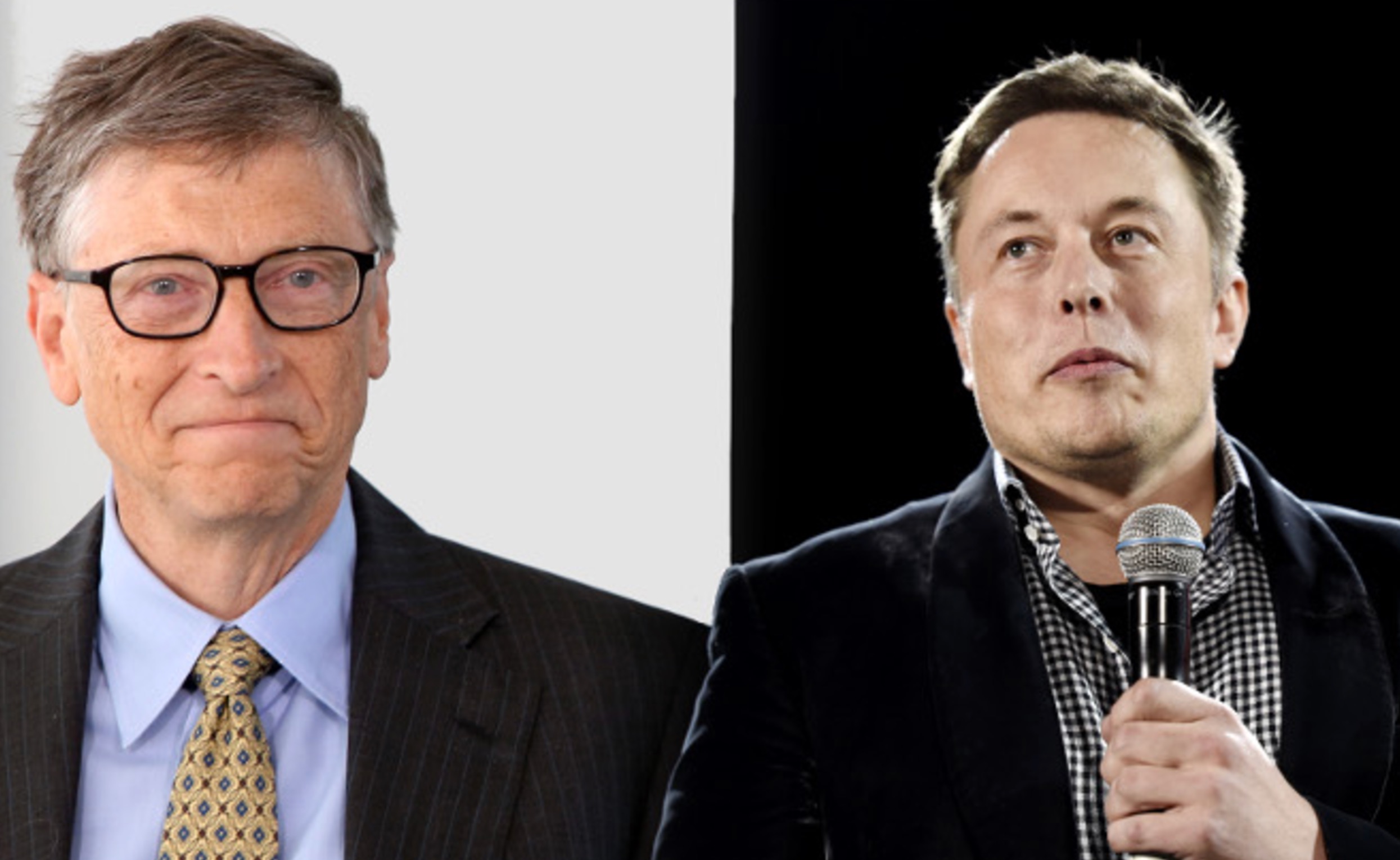
Elon Musk took his latest barb at former Microsoft CEO Bill Gates over his short position against the company, which the two have had some tensions over for a number of years.
Gates admitted to Musk several years ago through a text message that he still held a short position against his sustainable car and energy company. Ironically, Gates had contacted Musk to explore philanthropic opportunities.
Elon Musk explains Bill Gates beef: He ‘placed a massive bet on Tesla dying’
Musk said he could not take the request seriously, especially as Gates was hoping to make money on the downfall of the one company taking EVs seriously.
The Tesla frontman has continued to take shots at Gates over the years from time to time, but the latest comment came as Musk’s net worth swelled to over $600 billion. He became the first person ever to reach that threshold earlier this week, when Tesla shares increased due to Robotaxi testing without any occupants.
Musk refreshed everyone’s memory with the recent post, stating that if Gates still has his short position against Tesla, he would have lost over $10 billion by now:
Bill Gates placed a massive short bet against Tesla of ~1% of our total shares, which might have cost him over $10B by now
— Elon Musk (@elonmusk) December 17, 2025
Just a month ago, in mid-November, Musk issued his final warning to Gates over the short position, speculating whether the former Microsoft frontman had still held the bet against Tesla.
“If Gates hasn’t fully closed out the crazy short position he has held against Tesla for ~8 years, he had better do so soon,” Musk said. This came in response to The Gates Foundation dumping 65 percent of its Microsoft position.
Tesla CEO Elon Musk sends final warning to Bill Gates over short position
Musk’s involvement in the U.S. government also drew criticism from Gates, as he said that the reductions proposed by DOGE against U.S.A.I.D. were “stunning” and could cause “millions of additional deaths of kids.”
“Gates is a huge liar,” Musk responded.
It is not known whether Gates still holds his Tesla short position.


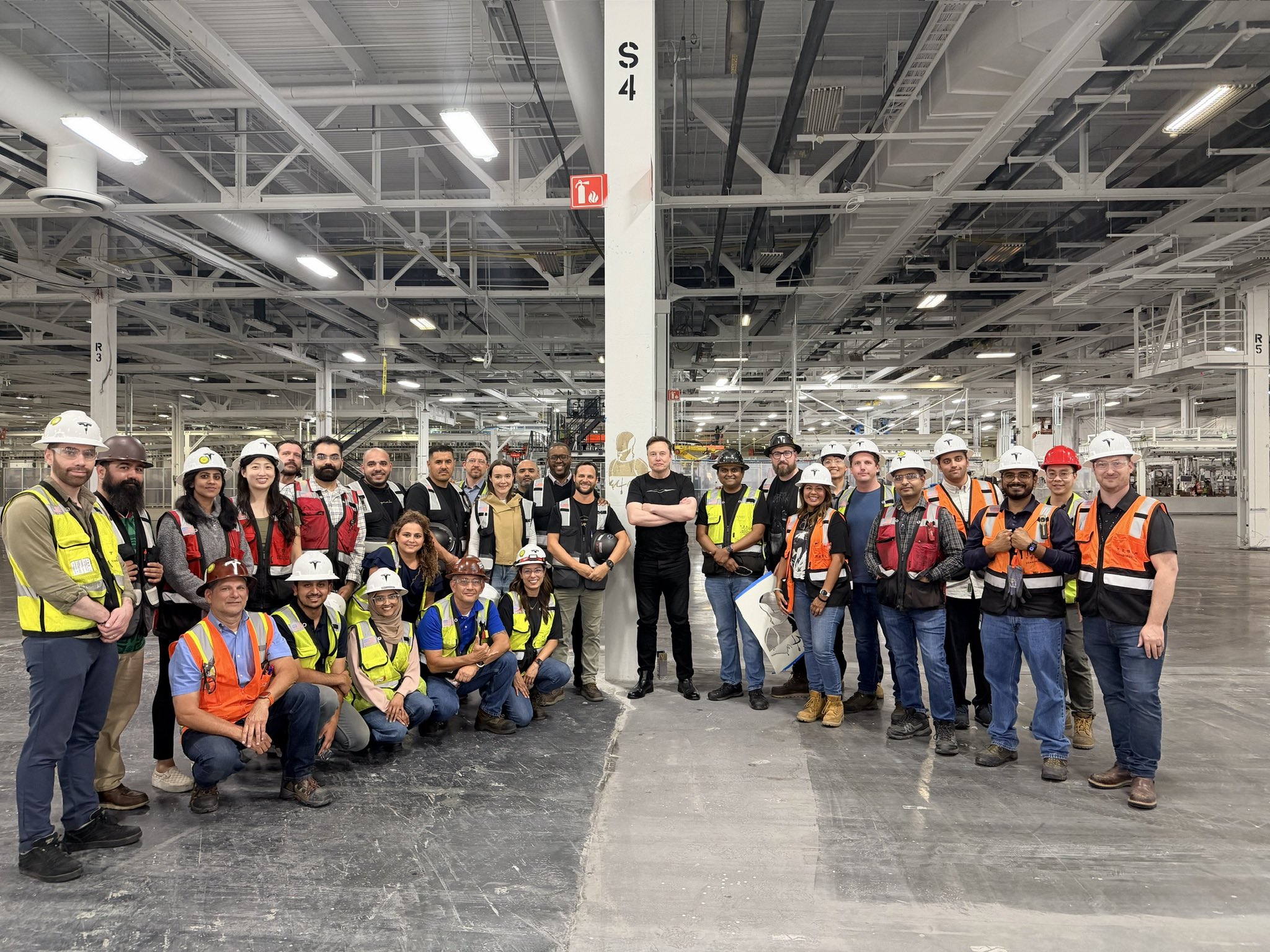
Tesla CEO Elon Musk posted a photo of himself standing with the Optimus production team inside Tesla’s Fremont factory, arms crossed amid workers in hard hats and safety vests. The image captures a pivotal industrial shift: the same facility space once dedicated to building Tesla’s flagship Model S sedan and Model X SUV is now home to the company’s humanoid robot manufacturing line.
Walking the Optimus production line in Fremont pic.twitter.com/ABS0tuRibW
— Elon Musk (@elonmusk) July 1, 2026
Tesla’s Fremont Factory, acquired in 2010 from the former NUMMI joint venture between Toyota and GM, has been the company’s original U.S. manufacturing hub since Model S production began in 2012.
The Model X followed soon thereafter. These premium vehicles offered lower annual volumes, recently around 30,000 combined, compared to the high-volume Model 3 and Model Y lines that continue around the site. Over their combined run, the S and X accounted for roughly 610,000 units.
In late January 2026, during Tesla’s Q4 2025 earnings call, Elon Musk announced the end of Model S and Model X production in Q2 2026. The final vehicles rolled off the line in early May. Rather than retooling for another vehicle, Tesla chose to convert the dedicated S/X assembly area into a dedicated Optimus Gen 3 production line.
Model 3 and Y manufacturing remains unaffected. Tesla’s official Fremont Factory page now lists Optimus alongside the 3 and Y as core products.
The conversion was executed with remarkable speed. After production stopped, crews dismantled the existing vehicle line and installed entirely new modular equipment—including lines sourced from Germany and dozens of sub-lines for actuators, batteries, and other components—in roughly four months.
Musk described the timeline as “insanely fast,” noting it would be unprecedented for any other manufacturer. Initial Optimus output is expected to ramp slowly due to the robot’s roughly 10,000 unique parts and the brand-new production processes involved. The Fremont line targets an eventual capacity of 1 million Optimus units per year.
Tesla isn’t joking about building Optimus at an industrial scale: Here we go
Optimus Development Timeline
- August 19, 2021: Optimus (then called Tesla Bot) formally announced at Tesla’s first AI Day. A concept video showed a person in a suit demonstrating the vision for a general-purpose humanoid capable of dangerous, repetitive, or boring tasks using the same AI architecture as Full Self-Driving.
- 2022: Early prototypes displayed. At the second AI Day in September, semi-functional units demonstrated walking across a stage and basic arm movements
- 2023: September videos showed improved capabilities, including sorting colored blocks, precise limb awareness, and holding a Yoda pose.
- 2024-early 2025: Factory integration videos showed Optimus navigating workspaces and handling objects like battery cells.
- January 2026: Gen 3 mass-production activities began at Fremont, with reports of over 1,000 Gen 3 units already operating inside the factory for real-world learning and AI training
- April 2026: Musk confirms Optimus production on converted Fremont line would begin in late July or August 2026. The Gen 3 reveal, originally eyed for Q1, was pushed closer to production start. A second, much larger Optimus factory at Giga Texas is under construction, with volume production targeted for Summer 2027 and long-term capacity of 10 million units annually
- July 1, 2026: Musk’s on-site visit and team photo confirm the Optimus line is operational and the transition is actively progressing
Tesla positions Optimus as potentially its largest project ever, leveraging vertical integration, AI expertise, and car-like manufacturing know-how to scale humanoid robots first for its own factories and later for broader industrial and consumer use.
The Fremont conversion serves as a critical proving ground for this ambitious new chapter in Tesla’s already-rich history.
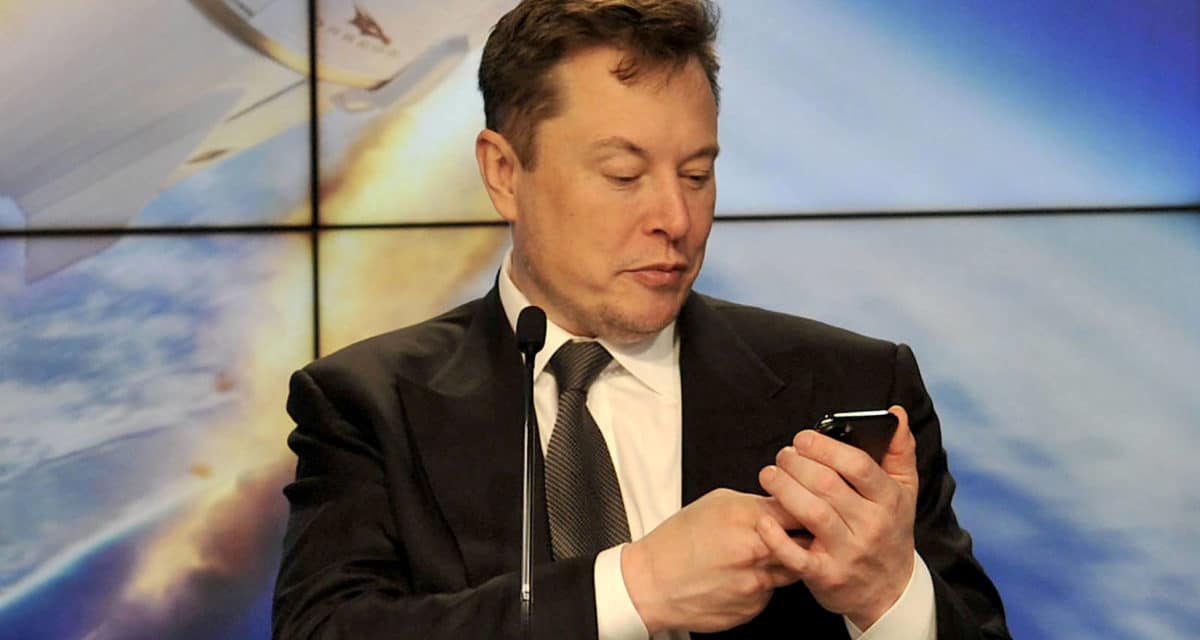
For years, there have been images and videos across social media platforms that have reminded me of when I was a 15-year-old kid teased by “Xbox 720” videos on YouTube. These videos are of the supposed “Tesla Phone” that Elon Musk was secretly developing in between leading Tesla with its electric cars and SpaceX with its reusable rockets.
Would you buy a Tesla phone ? pic.twitter.com/aaTwvvIJit
— Tesla Owners Silicon Valley (@teslaownersSV) October 6, 2023
Although Musk has put those rumors to bed several times, it was never completely out of the realm that he could get involved in cell phones in some capacity. Think outside the box and more macro-level, though. Instead of reinventing the computer, Musk reinvented connectivity by developing Starlink with SpaceX.
It could be something similar, TD Cowen analyst Gregory Williams said in a note last week, where he hinted SpaceX could be gathering some steam to acquire T-Mobile.
Williams said it would be the “clear choice” for SpaceX if it decided to go through with a network acquisition. He also suggested AT&T.
The move would be possible through selling more of its own stock, which would help SpaceX raise the money to purchase T-Mobile, which would cost roughly $300 billion. It could be one of the moves SpaceX makes post-IPO in terms of an acquisition: it already acquired Cursor AI for $60 billion.
Other analysts, like Dan Ives of Wedbush, believe SpaceX and Tesla will eventually merge into one anyway, and that conglomeration could come as soon as this year, some have said.
The implications of SpaceX purchasing T-Mobile are massive. A combined entity would create a truly ubiquitous network: T-Mobile’s terrestrial 5G towers and Starlink’s growing constellation of Direct-to-Cell satellites. This would essentially eliminate dead zones across the U.S. and potentially globally.
SpaceX would instantly become a full-scale facilities-based carrier with satellite differentiation; a huge advantage. This would pressure AT&T and Verizon heavily.
There are also concerns like a potential reduction in long-term competition, and of course, a deal of that size would face intense scrutiny from government agencies.
The strategic fit is compelling due to the existing Starlink–T-Mobile partnership and complementary technologies (space + terrestrial). It could create a dominant integrated communications player. However, the regulatory, financial, and execution hurdles are enormous — this remains highly speculative with no indication SpaceX is actively pursuing it right now.
Elon Musk
SpaceX’s newest Starmind will make earth data centers obsolete
Elon Musk confirmed Starmind as SpaceX’s AI satellite constellation name, targeting one million orbital compute nodes.

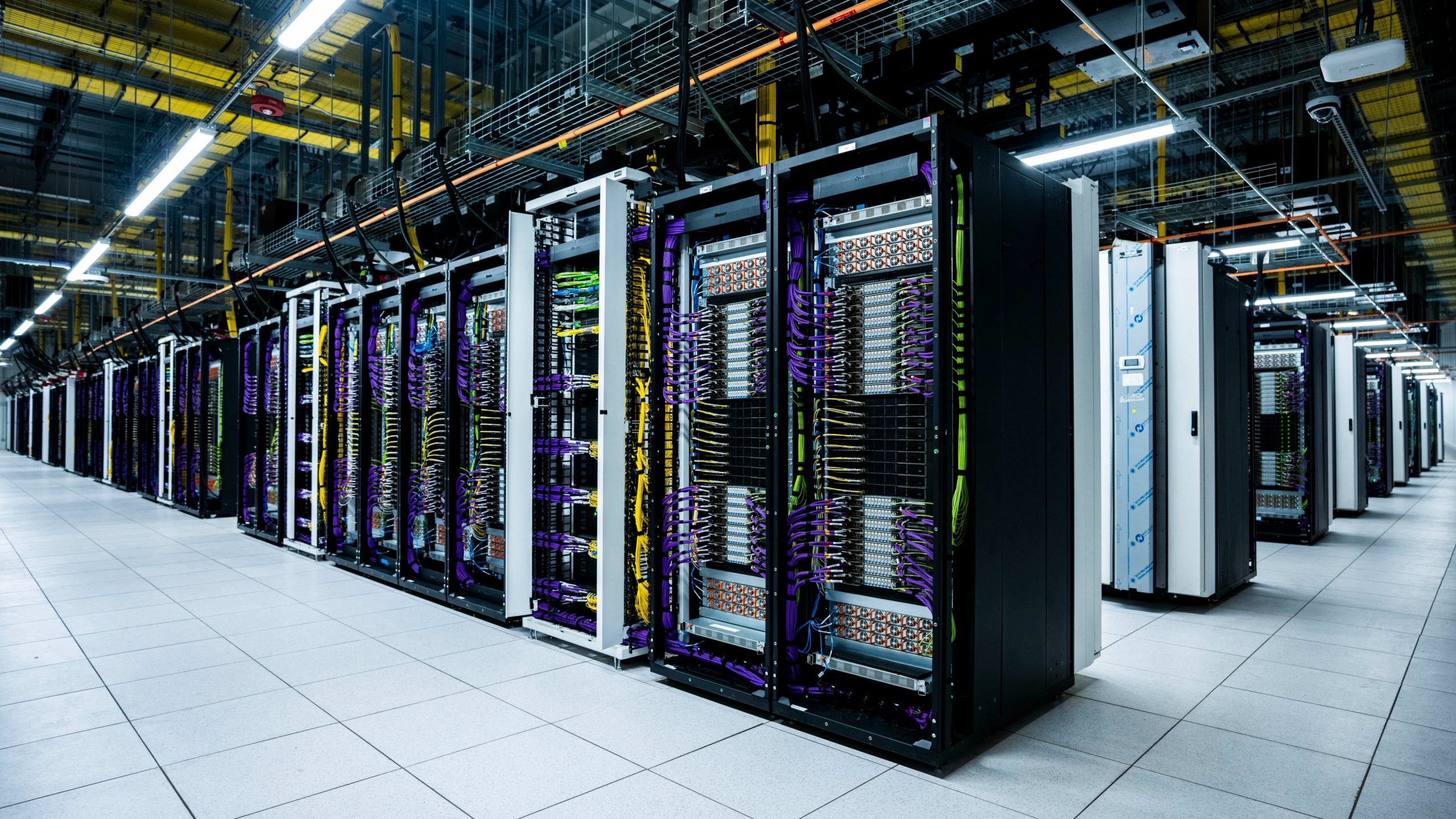
Elon Musk confirmed that Starmind will be the official name of SpaceX’s planned AI satellite constellation, following a trademark filing by xAI that surfaced earlier this week. Starmind is what’s being described to the FCC as a constellation of up to one million AI satellites
It’s worth noting that SpaceX’s Starlink communication satellite and Starmind are built on the same orbital infrastructure concept but serve entirely different purposes. Starlink is a connectivity network, with satellites receiving and relaying data between points on Earth, and functioning as a high-speed internet backbone in space. The satellites themselves do not process or think, and move information from one place to another, the same function a fiber cable performs underground.
SpaceX just forced Verizon, AT&T and T-Mobile to team up for the first time in history
Starmind, on the other hand, is something completely different, and tather than moving data, its satellites would compute data through artificial intelligence and directly in orbit using onboard processors powered by large solar arrays. Where a Starlink satellite is essentially a very fast pipe, a Starmind satellite is a server. The practical implication is that Starmind would allow AI models to run inference, process queries, and generate outputs from space, then beam results down to users anywhere on Earth within milliseconds, and without the data ever needing to travel to a terrestrial data center.
Starship will be able to carry 30 to 50 AI1 satellites per launch, delivering the equivalent of dozens of server racks per flight, with no land acquisition, no power grid approval, and no cooling infrastructure required on the ground.
SpaceX is pursuing this new technology as terrestrial data centers are running into hard limits such as lack of physical space, community opposition, and power and water consumption at a scale that is increasingly difficult to permit. Space has unlimited solar power, natural vacuum cooling, and no zoning boards. Musk said in a June 8 video presentation that he expects space to become the lowest-cost location to deploy AI compute within two to three years. Two AI1 prototypes are scheduled to launch in early 2027, with volume production targeted for the end of that year at a new facility called Gigasat.
The real world applications Starmind enables extend well beyond powering Grok. A constellation of orbiting AI processors could run inference workloads for any paying customer, anywhere on Earth, with latency measured in milliseconds rather than the seconds associated with ground-based cloud routing across continents. Starmind, if it scales as described, would make SpaceX the landlord of AI compute the same way Starlink made it the landlord of satellite internet.
Tesla brings Model Y L ‘Launch Series’ to the U.S. at $61,990

Tesla just told us twice that Model Y L is coming to the U.S.


