Elon Musk
Elon Musk proposes Grok 5 vs world’s best League of Legends team match
Musk’s proposal has received positive reception from professional players and Riot Games alike.

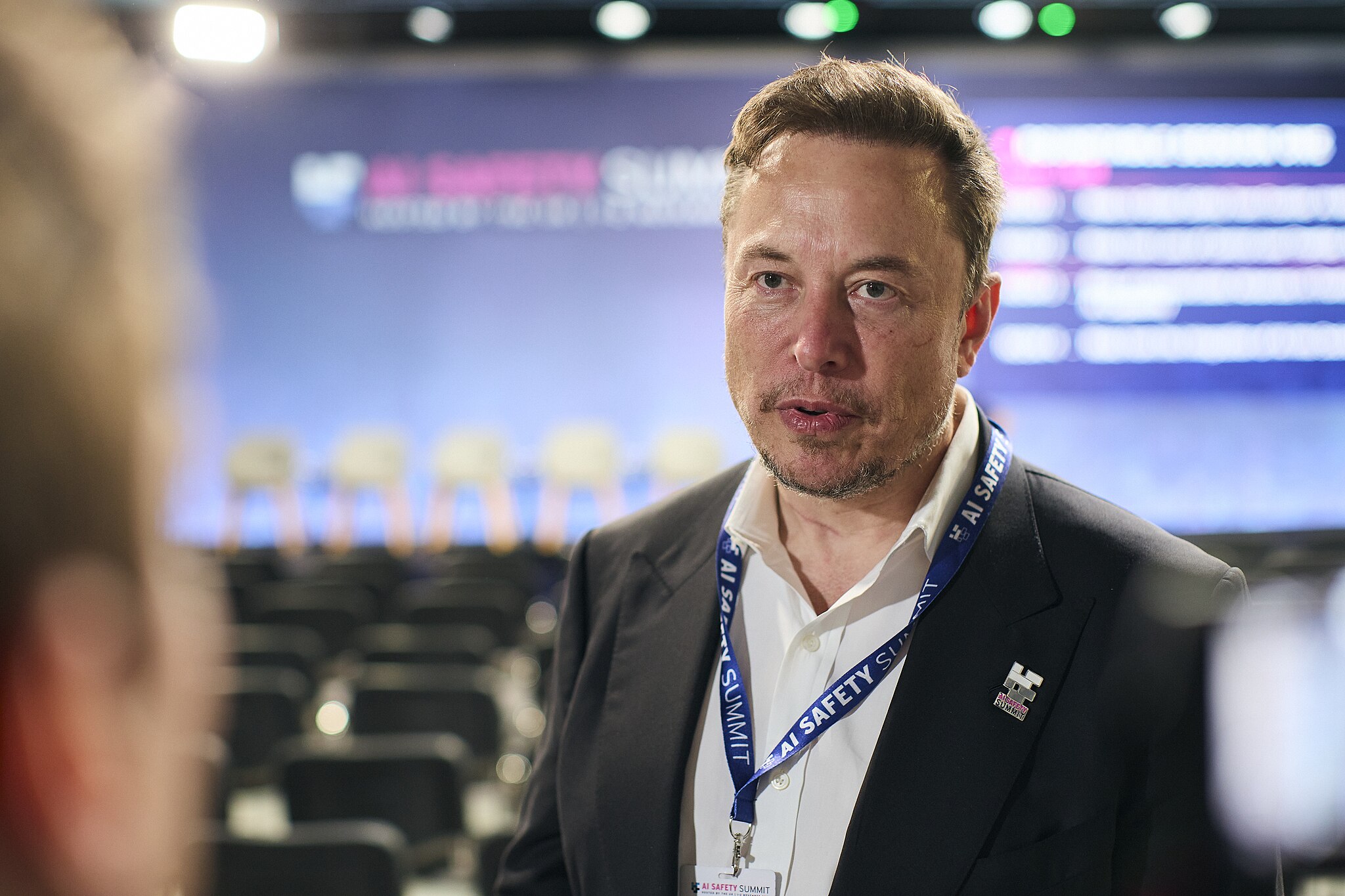
Elon Musk has proposed a high-profile gaming challenge for xAI’s upcoming Grok 5. As per Musk, it would be interesting to see if the large language model could beat the world’ best human League of Legends team with specific constraints.
Musk’s proposal has received positive reception from professional players and Riot Games alike, suggesting that the exciting exhibition match might indeed happen.
Musk outlines restrictions for Grok
In his post on X, Musk detailed constraints to keep the match competitive, including limiting Grok to human-level reaction times, human-speed clicking, and viewing the game only through a camera feed with standard 20/20 vision. The idea quickly circulated across the esports community, drawing commentary from former pros and AI researchers, as noted in a Dexerto report.
Former League pro Eugene “Pobelter” Park expressed enthusiasm, offering to help Musk’s team and noting the unique comparison to past AI-versus-human breakthroughs, such as OpenAI’s Dota 2 bots. AI researcher Oriol Vinyals, who previously reached Grandmaster rank in StarCraft, suggested testing Grok in RTS gameplay as well.
Musk welcomed the idea, even responding positively to Vinyals’ comment that it would be nice to see Optimus operate the mouse and keyboard.
Pros debate Grok’s chances, T1 and Riot show interest
Reactions weren’t universally optimistic. Former professional mid-laner Joedat “Voyboy” Esfahani argued that even with Grok’s rapid learning capabilities, League of Legends requires deep synergy, game-state interpretation, and team coordination that may be difficult for AI to master at top competitive levels. Yiliang “Doublelift” Peng was similarly skeptical, publicly stating he doubted Grok could beat T1, or even himself, and jokingly promised to shave his head if Grok managed to win.
T1, however, embraced the proposal, responding with a GIF of Faker and the message “We are ready,” signaling their willingness to participate. Riot Games itself also reacted, with co-founder Marc Merrill replying to Musk with “let’s discuss.” Needless to say, it appears that Riot Games in onboard with the idea.
Though no match has been confirmed, interest from players, teams, and Riot suggests the concept could materialize into a landmark AI-versus-human matchup, potentially becoming one of the most viewed League of Legends events in history. The fact that Grok 5 will be constrained to human limits would definitely add an interesting dimension to the matchup, as it could truly demonstrate how human-like the large language model could be like in real-time scenarios.
Tesla has passed a key milestone, and it was one that CEO Elon Musk initially mentioned more than nine years ago when he published Master Plan, Part Deux.
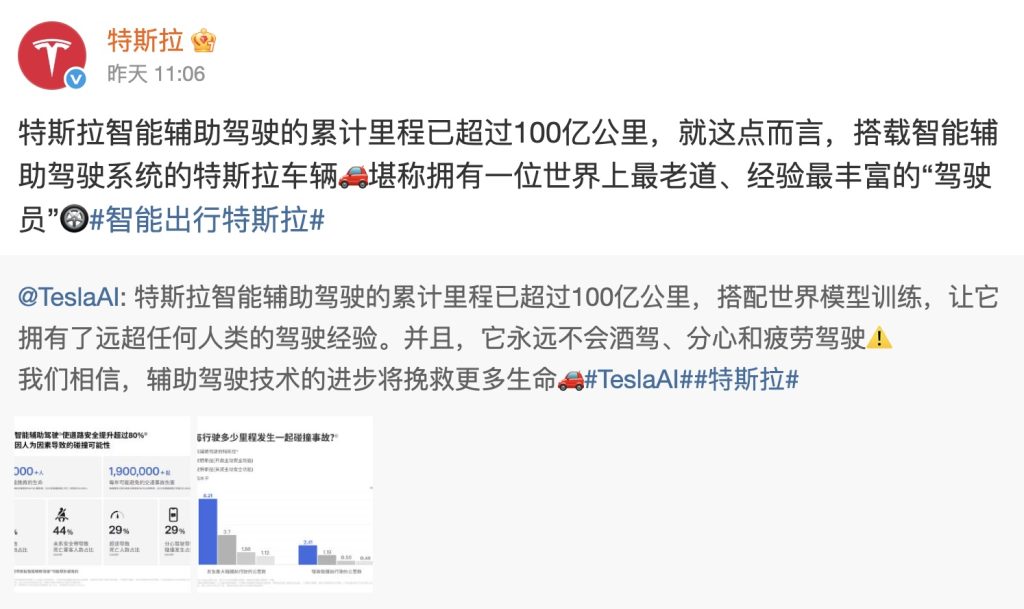
As per Tesla China in a post on its official Weibo account, the company’s Autopilot system has accumulated over 10 billion kilometers of real-world driving experience.
Tesla China’s subtle, but huge announcement
In its Weibo post, Tesla China announced that the company’s Autopilot system has accumulated 10 billion kilometers of driving experience. “In this respect, Tesla vehicles equipped with Autopilot technology can be considered to have the world’s most experienced and seasoned driver.”
Tesla AI’s handle on Weibo also highlighted a key advantage of the company’s self-driving system. “It will never drive under the influence of alcohol, be distracted, or be fatigued,” the team wrote. “We believe that advancements in Autopilot technology will save more lives.”
Tesla China did not clarify exactly what it meant by “Autopilot” in its Weibo post, though the company’s intense focus on FSD over the past years suggests that the term includes miles that were driven by FSD (Beta) and Full Self-Driving (Supervised). Either way, 10 billion cumulative miles of real-world data is something that few, if any, competitors could compete with.
Advertisement
–>
Elon Musk’s 10-billion-km estimate, way back in 2016
When Elon Musk published Master Plan Part Deux, he outlined his vision for the company’s autonomous driving system. At the time, Autopilot was still very new, though Musk was already envisioning how the system could get regulatory approval worldwide. He estimated that worldwide regulatory approval will probably require around 10 billion miles of real-world driving data, which was an impossible-sounding amount at the time.
“Even once the software is highly refined and far better than the average human driver, there will still be a significant time gap, varying widely by jurisdiction, before true self-driving is approved by regulators. We expect that worldwide regulatory approval will require something on the order of 6 billion miles (10 billion km). Current fleet learning is happening at just over 3 million miles (5 million km) per day,” Musk wrote.
It’s quite interesting but Tesla is indeed getting regulatory approval for FSD (Supervised) at a steady pace today, at a time when 10 billion miles of data has been achieved. The system has been active in the United States and has since been rolled out to other countries such as Australia, New Zealand, China, and, more recently, South Korea. Expectations are high that Tesla could secure FSD approval in Europe sometime next year as well.


Elon Musk
Elon Musk says Tesla’s Roadster demo could be a bang, quite literally
Musk says tonight’s Roadster demo will be a banger, maybe literally. The clues add up.

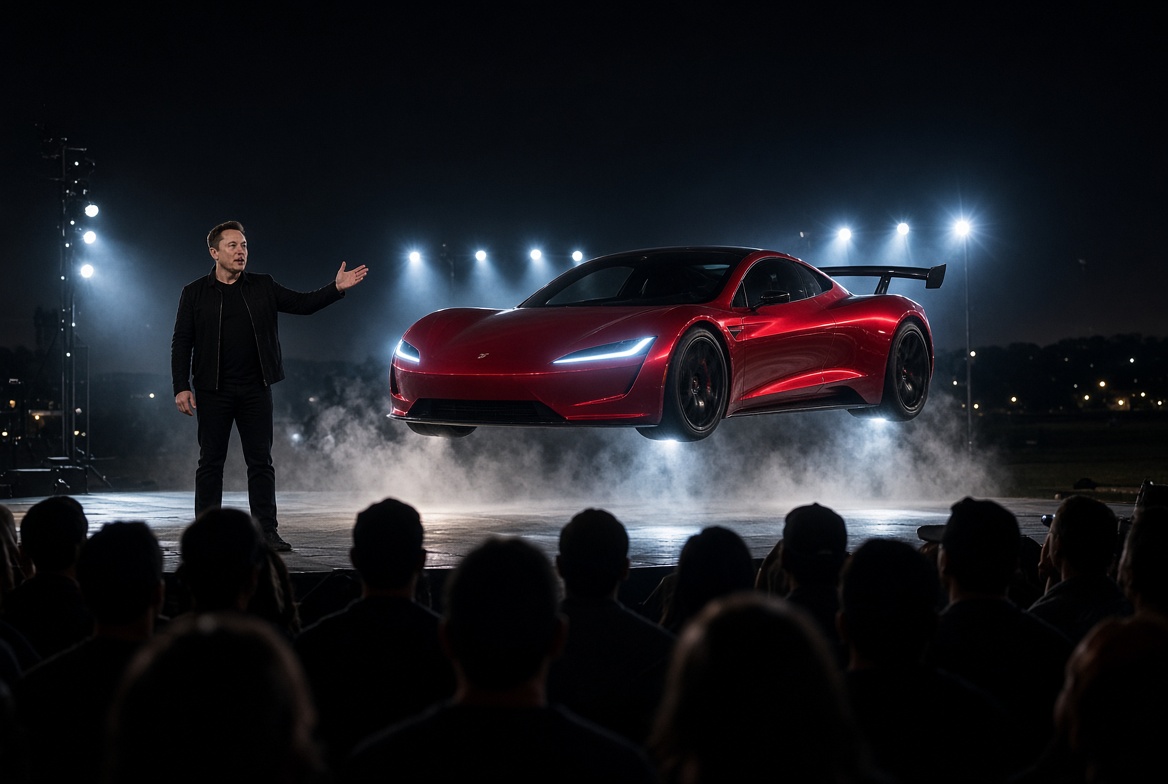
Elon Musk spent Wednesday and Thursday stacking teases on top of Tesla’s Roadster event, and the wording is getting harder to read as routine hype. Tesla streams the unveil tonight at 7:55 p.m. Central on X. Musk has called it “a candidate for greatest product demo of all time,” then added that “this demo will be a BANGER, probably metaphorically, though some chance literally.”
New Roadster is
beyond movies,
beyond imagination,
beyond human,
yet still made
by humans
on Earth— Elon Musk (@elonmusk) October 15, 2026
The “some chance literally” part is the line to watch. The Roadster has been tied to a SpaceX option package since 2018, and as we reported when the date was announced, the system is reportedly codenamed A71 and uses cold gas thrusters fed by a composite overwrapped pressure vessel, the same tank design SpaceX uses on Falcon 9. Musk has said a thruster equipped car could reach 60 mph in about 1.1 seconds. Cold gas thrusters firing at full output are loud, and reports ahead of the event say the car will be unmanned with spectators kept several hundred yards back. A literal bang could simply mean a demonstration that sounds like one, though it is also an admission that something could go wrong on stage.
Then there is “Timing is everything,” which Musk posted a day earlier. Stocktwits noted that 7:55 p.m. is 19:55 on a 24 hour clock, which echoes 1955, the year Marty McFly travels to in Back to the Future. Musk has made that connection before. In 2019 he replied to an animation of a flying DeLorean by saying the new Roadster “will actually do something like this.” Nothing from Tesla confirms the movie reference, but the stream time was chosen by someone, and Tesla has not been shy about this kind of wink.
Also, Tesla said it moved the event because it “can only be held outdoors,” and Musk then wrote that the demo was postponed “due to high winds,” as Teslarati covered at the time. A car running a standing start in front of a crowd shrugs off wind. A car that leaves the ground does not. The venue near SpaceX’s McGregor test site and the FAA airspace closures reported around the original date point the same way, though we also noted the delay could be a plain safety precaution. Musk has also described the new Roadster as “beyond movies, beyond imagination, beyond human, yet still made by humans on Earth.”
The only official figures remain the 2017 ones: 620 miles of range, a top speed above 250 mph, a 1.9 second 0 to 60 time, and prices of $200,000 for the base car and $250,000 for the Founders Series. Production is expected at Giga Texas in 2027 or 2028. Tesla has said the event will cover pricing, specifications and production targets, and its livestream preview has the full rundown. Tesla reports third quarter earnings on October 21, so whatever lands tonight will be fresh going into that call. We will have live coverage as soon as the stream starts.
Elon Musk
Elon Musk breaks his silence on the Starlink impact to Ukraine drones
Musk says the US military and president set Starshield limits, not SpaceX, amid Ukraine complaints.
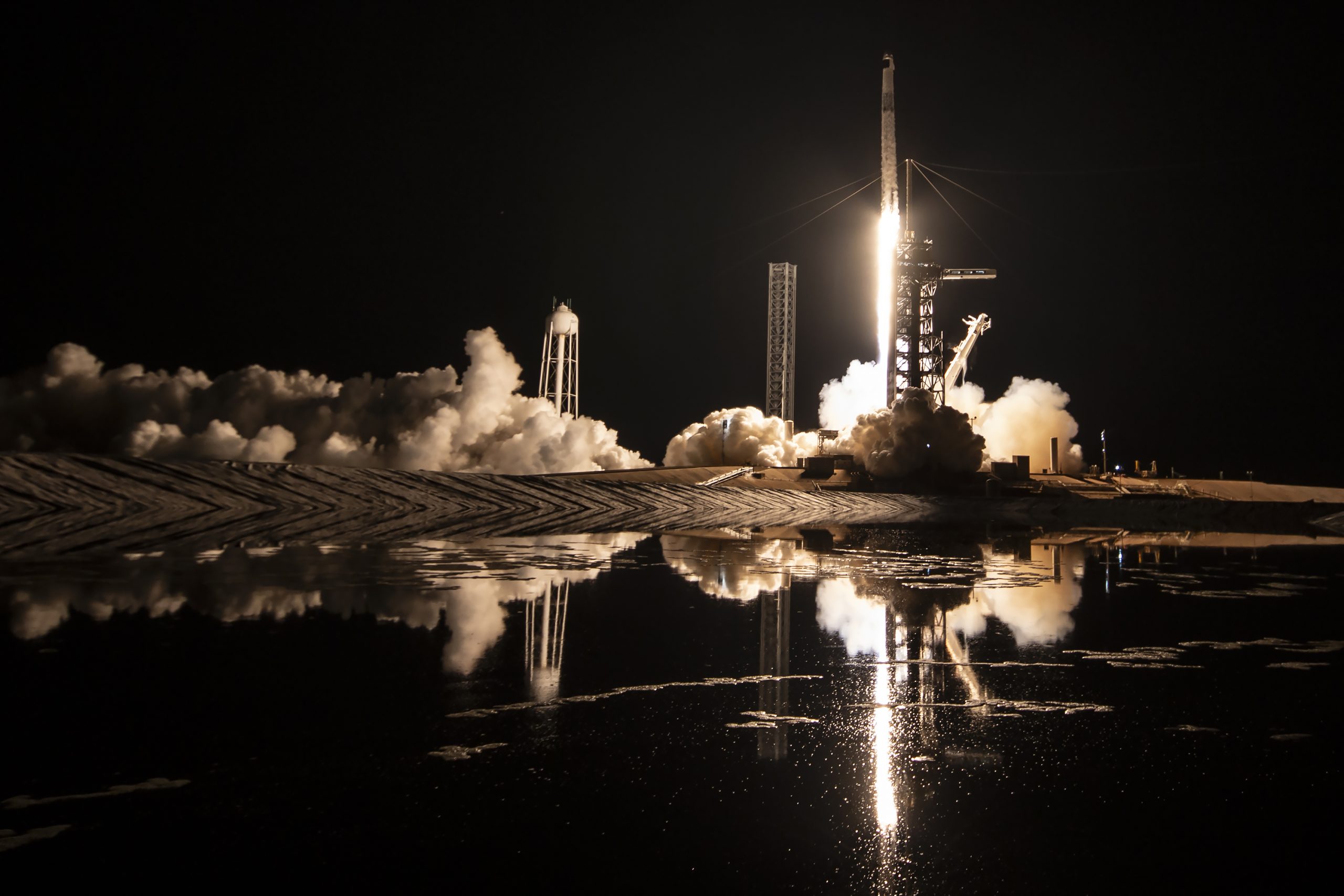
Elon Musk says the speed limit cutting out Ukraine’s military Starlink terminals is not SpaceX’s decision. In a post on X Wednesday, Musk wrote that “Starshield systems are owned and controlled by the US government. Any limits on speed or usage are decided by the US military and ultimately POTUS.” He added that Starlink is a commercial service limited to civilian or defensive activities and “cannot be used for offensive military action, as doing so would be inappropriate for a commercial company.”
He was replying to Mykhailo Fedorov, Ukraine’s former defense minister, who had thanked Musk for restoring connectivity at speeds up to 160 km/h and said removing the Starshield limit entirely is “now critical for Ukraine’s defense.”
Starshield systems are owned and controlled by the US government. Any limits on speed or usage are decided by the US military and ultimately POTUS.
Starlink is a commercial service owned and controlled by SpaceX. Usage of Starlink is limited to civilian or defensive activities and cannot be used for offensive military action, as doing so would be inappropriate for a commercial company.
— Elon Musk (@elonmusk) October 14, 2026
The complaint started Tuesday night, when Ukrainian officials said military terminals began losing service above roughly 100 mph. Presidential adviser Serhiy Beskrestnov said the defense forces got no warning and several missions were disrupted, as Teslarati reported earlier Wednesday. The 7th Rapid Reaction Corps told Reuters connections dropped for 10 to 20 seconds at speeds well below the limit, which made drones harder to control. Poland’s foreign minister, Radoslaw Sikorski, asked Musk on X whether he is “playing politics with your products again.”
That is why the Starlink and Starshield distinction matters. SpaceX introduced Starshield in 2022 as the government version of Starlink, with an initial focus on Earth observation, communications and hosted payloads. It won a Space Force contract in 2023 with a $70 million ceiling. In December 2024, the Pentagon moved Ukraine’s terminals onto Starshield, covering about 3,000 units across two contracts. Ukraine’s military connections therefore run through a service that Musk now says sits under Washington’s control.
While Musk’s post describes who holds authority, it does not infer that anyone ordered the limit, and neither SpaceX nor the US government has confirmed who set it. Ukrainian officials have pointed to the timing, which follows President Trump’s push for an energy ceasefire and Musk’s Saturday post that “Zelensky has gone too far.” The BBC noted Trump denied threatening to restrict intelligence sharing with Kyiv, and no evidence has been presented that Washington requested the cap.
The episode also revives a promise from 2025. After Poland accused him of threatening Ukraine’s access, Musk said Starlink “will never turn off its terminals” and would not be used as a bargaining chip. Poland has since supplied more than 29,000 terminals to Ukraine. Teslarati also covered Kyiv’s search for Starlink alternatives in 2025, and the latest dispute gives that search new urgency.
Elon Musk
Ukraine says Starlink is cutting out its military drones as Poland calls out Elon Musk
Ukrainian officials allege SpaceX limited military Starlink speeds, disrupting drone missions; SpaceX has not commented.
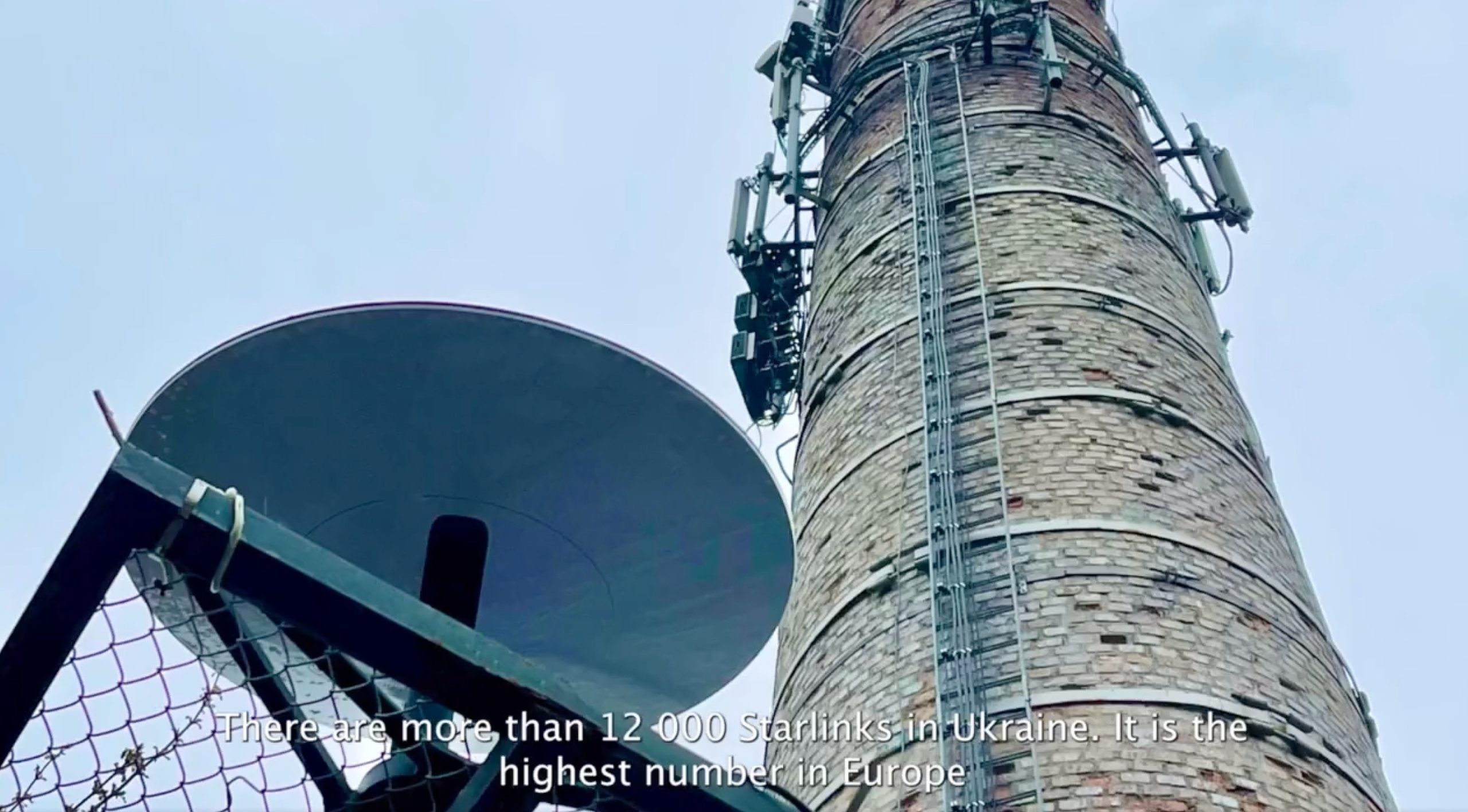
Ukrainian officials are accusing SpaceX of placing a speed limit on the military version of Starlink that their forces use to fly drones, but SpaceX has not confirmed that any change was made. Presidential adviser Serhiy Beskrestnov said in a Telegram post on Wednesday that Starshield terminals have begun losing service when they move faster than about 100 miles per hour, according to a Reuters report. “Our defense forces did not receive a warning about this limitation, and this led to the disruption of several missions,” he wrote.
Ukraine’s 7th Rapid Reaction Corps told Reuters that connections dropped for 10 to 20 seconds at just 68 to 75 mph, which made the drones harder to control. Volunteer Serhiy Sternenko, citing military reports, said the dropouts are now starting at 37 to 43 mph. These accounts come from Ukrainian officials and military sources and have not been independently verified. Regular civilian terminals were reportedly not affected, according to EUalive.
.@POTUS: We told Zelensky, ‘You can do whatever you want to Russia, but don’t hit the refineries because that’s a world problem.’ And what does he do? He goes and hits the diesel fuel. He better damn well stop. https://t.co/CdRlMcPlKr
— Rapid Response 47 (@RapidResponse47) October 10, 2026
SpaceX has not publicly commented or explained what, if anything, changed. Beskrestnov and other Ukrainian officials believe the issue is intentional and point to the timing. Washington has been pressing Kyiv to stop long range strikes on Russian oil refineries after President Trump called for an “energy ceasefire,” and Musk posted on Saturday that “Zelensky has gone too far.” EUalive noted that neither Ukrainian nor Polish officials have presented evidence that the limit was ordered by Washington or by SpaceX, so the link to politics remains an allegation. Other explanations, such as a technical or policy change affecting fast moving terminals, have not been ruled out.
Poland’s foreign minister, Radosław Sikorski, responded on X by quote tweeting a Kyiv Independent report and writing: “Hey, @elonmusk, big man, are you playing politics with your products again? As your European customers, we are watching you.” Poland is the largest funder of Ukraine’s Starlink service, having supplied more than 29,000 terminals and covering operating costs Sikorski has put at roughly $50 million a year. The wording echoes their 2025 clash, when Musk told Sikorski to “be quiet, small man.” At the time of writing, neither Musk nor SpaceX had responded to the claims.
Hey, @elonmusk, big man, are you playing politics with your products again?
As your European customers, we are watching you.— Radosław Sikorski 🇵🇱🇪🇺 (@sikorskiradek) October 14, 2026
The dispute sits on top of a long history. Musk confirmed in February 2022 that Starlink was active in Ukraine after a request from a Ukrainian minister. That October, SpaceX asked the Pentagon to share the bill and Musk said the cost was approaching $20 million a month, before he reversed course and said SpaceX would keep paying. In December 2024 the Pentagon moved some of those terminals onto the Starshield service, the government version now at the center of the complaints.
SpaceX has also changed how its network treats certain terminals in Ukraine before, and that time it was with Kyiv’s cooperation. In February, Ukrainian officials confirmed that terminals believed to be used by Russian troops were disabled after coordination with SpaceX, a step that Ukrainian commanders later said hurt Russian assaults. Whether anything similar is behind the latest reports is unclear, which is why Kyiv is asking for answers.
Ukraine is already looking at backups. Defense tech company Stetman is developing its own satellite system, UASAT-NANO, and officials in Europe have discussed alternatives to Starlink since early 2025, though none match its scale yet.

Elon Musk says Tesla’s Roadster demo could be a bang, quite literally

Elon Musk breaks his silence on the Starlink impact to Ukraine drones

Tesla opens the Q&A for its biggest earnings call yet

The Pentagon taps Elon Musk to design the battlefield of the future

SpaceX reveals how its 1 Million AI satellite network will work and prevent space collisions


