Elon Musk
Elon Musk may rethink his charity pledge after Peter Thiel’s Bill Gates warning: report
Musk reportedly took Thiel’s suggestion seriously.

Reports have emerged suggesting that Elon Musk might be rethinking his promise to give away most of his fortune. This was reportedly due to his longtime friend Peter Thiel, who told the world’s richest man to withdraw from the Giving Pledge because his wealth could end up “in left-wing nonprofits chosen by Bill Gates.”
Thiel shared the story during a private lecture series in San Francisco in September. As noted in a Reuters report, Musk reportedly took Thiel’s suggestion seriously.
Thiel warned Musk about his fortune going to Gates-backed causes
Thiel said he even ran the math to make his point. By checking actuarial tables, he calculated that if Musk died within a year, his pledge would effectively direct $1.4 billion to Bill Gates. Musk reportedly said, “What am I supposed to do, give it to my children? You know, it would be much worse to give it to Bill Gates.”
Musk signed on to the Giving Pledge in 2012, two years after it was co-founded by Gates and Warren Buffett, as noted in a Daily Beast report. The initiative asks billionaires to donate the majority of their wealth to charitable causes either during their lifetime or through their wills. Gates’ foundation has focused on global health, education, and gender equality, areas Thiel has described as “left-leaning.”
Spokespeople for Thiel, Musk, and Gates have not issued a comment about the matter.
Elon Musk and Bill Gates
Thiel, who co-founded PayPal with Musk in 2000 before launching Palantir and becoming Facebook’s first outside investor, has maintained close ties to the Tesla and SpaceX CEO over the years. Musk, for his part, continues to donate through the Musk Foundation, which funds education, clean energy, and scientific research.
Elon Musk and Bill Gates’ relationship has taken a nosedive in recent years, especially amidst news that the Microsoft co-founder had taken a short bet against Tesla. Musk seemed to have taken Gates’ Tesla short personally, considering that the EV maker is fighting for sustainability, a cause that the Microsoft co-founder has supported.
Gates has also been skeptical of Tesla’s projects such as the Tesla Semi, which Gates noted was not feasible due to the limitations of battery technology. More recently, the two billionaires butted heads when Gates claimed that the cuts initiated by Musk’s DOGE initiative would cost 2 million lives. In a post on X, Musk responded by stating that “Gates is a huge liar.”



Elon Musk posted a candid admission on his social media platform X on June 9, declaring that he had been “clearly wrong” about Anthropic. The statement marked a notable reversal from his earlier skepticism toward the AI company.
In September, Musk had written, “Winning was never in the set of possible outcomes for Anthropic,” reflecting his view at the time that the startup had lacked the foundation or even the trajectory to succeed in what is an incredibly intense race for advanced artificial intelligence.
Musk’s latest post came amid discussion of Anthropic’s reliance on external compute resources. He praised the company’s progress, stating that Anthropic is “obviously currently the leader in AI” and that “no company has released a model as good as Mythos/Fable,” with expectations of a strong follow-up in Mythos 2.
The tone shifted dramatically from dismissal to acknowledgement of superior performance.
I was clearly wrong about Anthropic. They are obviously currently the leader in AI. No company has released a model as good as Mythos/Fable and they will undoubtedly have Mythos 2 ready soon.
And I would never cut them off in a way that hurt them badly, even as a competitor.…
— Elon Musk (@elonmusk) July 9, 2026
The context of Musk’s comments added significance. Anthropic has been operating under a recent compute deal with SpaceXAI, Musk’s AI infrastructure-focused venture. The pair entered a short-term GPU lease agreement initiated in May, providing Anthropic access to critical computing power for training and deploying its frontier models.
SpaceXAI signs agreement with Anthropic for massive AI supercomputer access
Some observers had speculated that Musk could leverage this dependency to disadvantage a rival. Musk directly addressed the possibility, writing, “I would never cut them off in a way that hurt them badly, even as a competitor. That’s not my style.”
To support his commitment to ethical competition, Musk referenced concrete examples from his other companies. Tesla famously open-sourced its entire portfolio of electric vehicle patents in 2014. The move was designed to accelerate the global adoption of sustainable transportation technology rather than protect proprietary advantages.
Tesla also made its Supercharger network available to competing electric vehicle manufacturers, transforming what could have remained an exclusive charging ecosystem into a shared infrastructure that benefits the broader industry and reduces barriers for EV adoption.
Musk further pointed to SpaceX’s practices, noting that the company launches satellites for competing commercial systems “with no increase in price or use of unfair terms.” He extended the principle to his social platform, observing that “even my worst enemies attack me on this platform,” underscoring preference for open discourse over retaliation.
These examples have illustrated Musk’s long-standing philosophy that long-term technological progress is best served by open competition and infrastructure sharing rather than leveraging market power to stifle rivals. In the fast-evolving AI sector, where compute resources and model capabilities determine leadership, Musk’s stance suggests a willingness to compete on innovation and performance alone.
Musk’s admission arrives as SpaceXAI itself advances its own frontier models while maintaining business relationships across the ecosystem. By publicly correcting his earlier assessment and reaffirming principles of fair play, Musk highlights a model of competition that prioritizes advancement of the field over short-term tactical advantages.
Elon Musk
Tesla FSD is about to know your specific house and neighborhood better than any map
Tesla confirmed it is building a feature that lets you teach your car where to go.

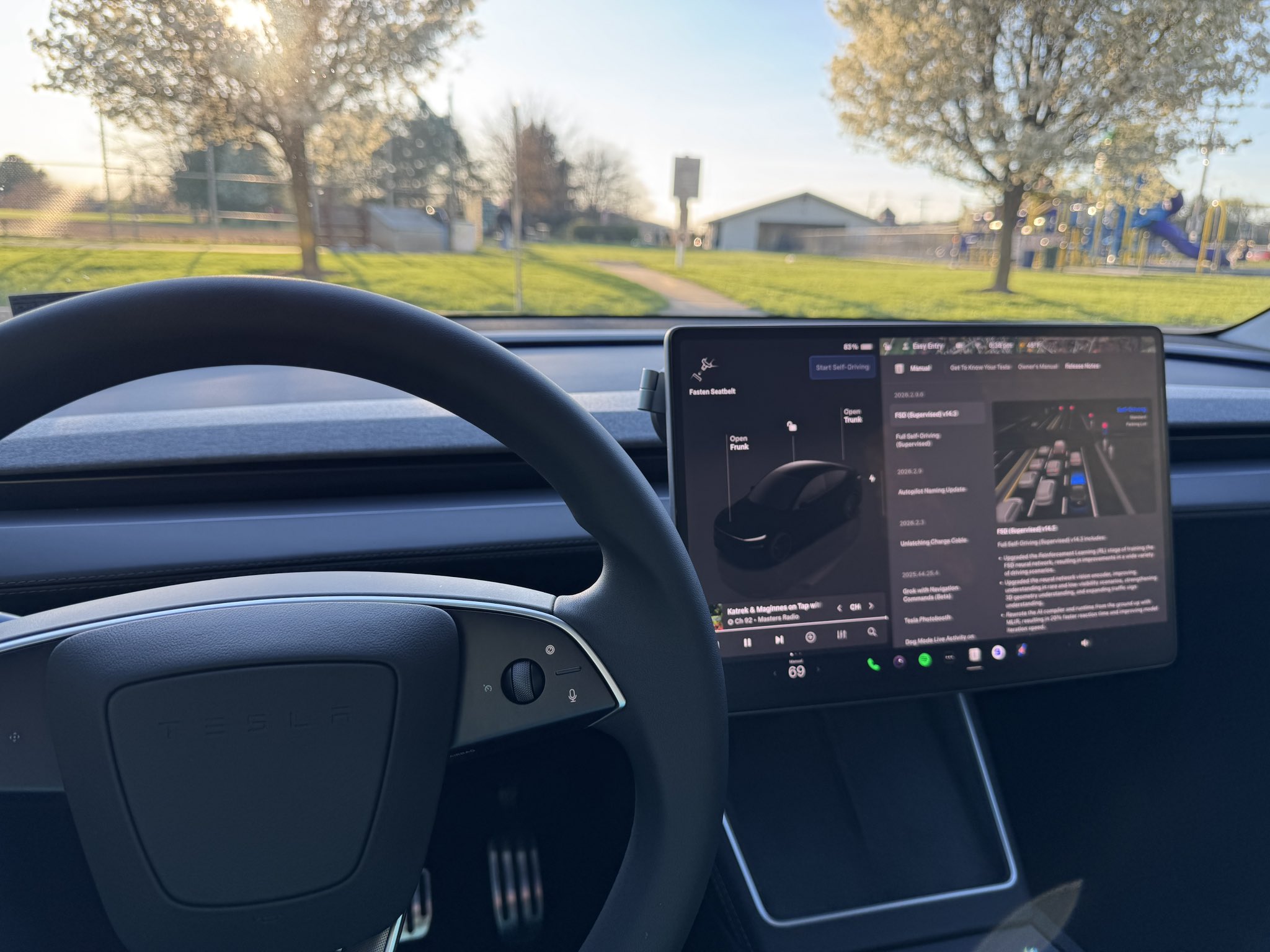
Tesla is building a feature that will let drivers talk to their car in plain language and teach it exactly what to do, with the vehicle remembering those instructions for every future trip. Tesla VP of AI Software Ashok Elluswamy confirmed it this week on X after a user pointed out one of FSD’s most persistent real-world limitations is that the system has no way to receive contextual instructions the way a human driver would.
“FSD would be twice as useful in neighborhoods if I could actually talk to the car and tell it which driveway to pull into, the same way I would with a person driving me home. Right now, there isn’t really an input for telling Tesla what color the house is or giving it specific context like that. Google Maps is also notorious for putting pins on houses that aren’t actually yours.” Tesla owner Chris further noted, “It would be so cool if I could talk to the car while going down my street and say something like, ‘It’s the white house on the left, just past that SUV,’ and then have FSD remember that for next time.”
FSD would be twice as useful in neighborhoods if I could actually talk to the car and tell it which driveway to pull into, the same way I would with a person driving me home.
Right now, there isn’t really an input for telling Tesla what color the house is or giving it specific…
— Chris (@ChrissGPT) July 8, 2026
This feature would carry more weight than it might seem. Grok has been available inside Tesla vehicles since July 2025, expanded to European vehicles in February 2026, and gained a hands-free “Hey Grok” wake word with location-based reminders and natural-language navigation in the Spring 2026 update. But up to this point, Grok has had no authority over how FSD actually drives. Lane changes, braking, speed, and parking maneuvers remain entirely within FSD’s autonomous decision-making loop. What Elluswamy confirmed is that the next step pushes Grok into a supervisor role, one that translates spoken intent directly into driving decisions.
Tesla teases greater Grok FSD integration and ‘Banish’ feature ‘in about 3 months’
Elluswamy acknowledged at a January 2026 conference that while fully integrated voice control is on Tesla’s roadmap, “it opens up an entire area of testing that we have to do. For example, you shouldn’t be able to tell the car to crash, and it shouldn’t crash.” Elon Musk subsequently confirmed on June 23 that Grok voice commands will pass to FSD’s planning layer by September 2026, a three month timeline from confirmation to deployment.
The deeper significance is what this does for Tesla’s AI training flywheel. Every time an owner corrects FSD with a spoken instruction and the car learns and remembers it, that interaction becomes a data point covering an edge case that no simulation or scripted test could have generated. A fleet of millions of Tesla vehicles crowdsourcing hyper-local contextual knowledge, which driveway, which gate entrance, which side of the street, builds a layer of geographic and behavioral intelligence that competitors without a comparable fleet simply cannot replicate at the same speed or scale.
As Teslarati has reported, Tesla’s Cybercab and robotaxi operations have expanded to Miami following the Austin launch, with rider profiles already collecting preference data. Voice-taught contextual instructions linked to individual rider profiles means a Cybercab could eventually know before it arrives exactly which entrance to use, where to wait, and how to navigate the final hundred feet of any trip it has made before.
Elon Musk
California snubs Tesla in its newly passed EV incentive that favors Rivian and Lucid
California passed a $135 million EV incentive that rewards Rivian and Lucid while sidelining Tesla
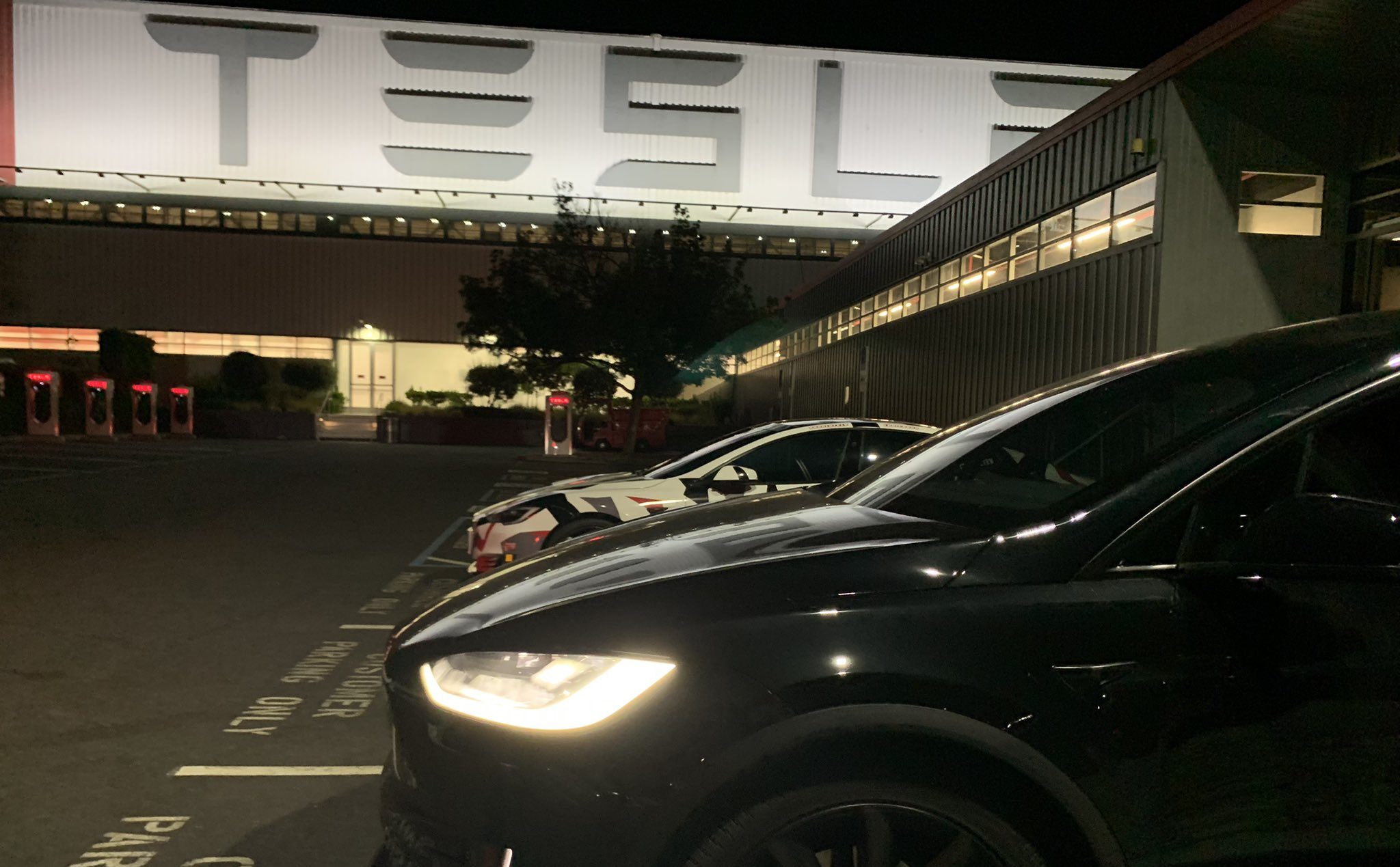
California just drew a line in the EV incentive sand to put Tesla on the wrong side of it. The state recently passed a $135 million program offering first-time electric vehicle buyers a direct incentive with no application required, but the rules were written in a way that leaves Tesla at a structural disadvantage compared to Rivian and Lucid.
The program caps eligible vehicles at $50,000 for new EVs and $25,000 for used ones. That pricing threshold rules out a significant portion of Tesla’s lineup, though some lower-priced Model 3 and Model Y configurations would still qualify. California-based automakers are exempt from the price cap entirely, regardless of what their vehicles cost. Rivian, headquartered in Irvine, and Lucid, based in the San Francisco Bay Area, both benefit from that exemption. Rivian’s R2 starts at roughly $45,000 but has versions above the cap. Lucid’s Air and Gravity start at $70,990 and $79,990 respectively, well above any threshold a non-California company would face.
California hits Tesla Cybercab and Robotaxi driverless cars with new law
Tesla built its reputation and a significant portion of its early market share in California, where EV adoption has consistently led the nation. The company operates its original factory in Fremont, California, and the state was home to Tesla’s headquarters for most of its existence. That changed in 2021 when Tesla moved its corporate headquarters to Austin, Texas. Since then, the relationship between the company and California Governor Gavin Newsom has been openly adversarial, with Musk and Newsom trading public criticism on multiple occasions.
California’s EV incentive landscape has shifted repeatedly in recent years, and Tesla has previously lost eligibility for state-level programs as its vehicles exceeded income-adjusted price thresholds. The federal $7,500 EV tax credit, which Tesla models have qualified for and lost depending on policy cycles, is no longer available after it expired without renewal, making state-level programs more meaningful to buyers than they have been in years.
The practical impact for buyers is more nuanced than the headline suggests. California residents purchasing a Tesla under $50,000 for the first time can still access the incentive. But the exemption written for California-based manufacturers is a structural advantage that rewards where a company plants its headquarters flag rather than where it builds its products, and Tesla moved that flag to Texas.

Tesla shows rapid teardown of Model S and X lines, paving the way for Optimus at Fremont

Elon Musk admits he was ‘clearly wrong’ about Anthropic


