News
Behind the Tesla and Elon Musk Attacks: Big Energy and Conservative Groups

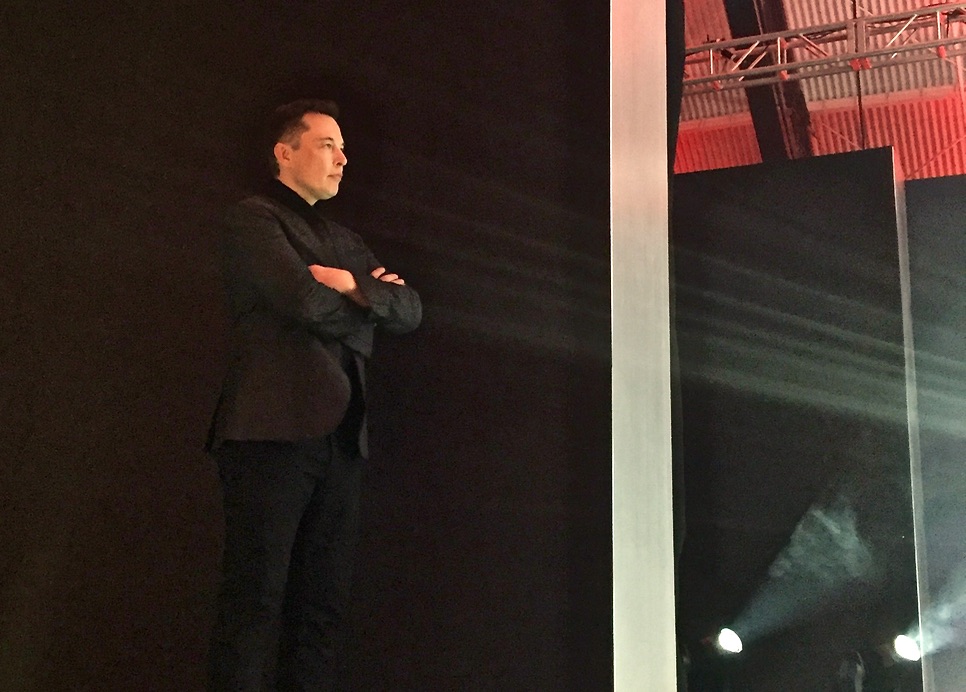
Elon Musk and Tesla Motors have their share of detractors, some of whom have become more vicious than usual as of late. According to a recent article published by The Drive, focused attacks on Tesla and SpaceX emanate from conservative group Citizens for the Republic. CftR is an organization founded in 1977 by Ronald Reagan that calls itself ” a national organization dedicated to revitalizing the conservative movement.” Its stated mission is to “ferret out corruption that wastes taxpayer dollars and continually undermines the American people in favor of the powerful and profitable.” CftR lists its national chairman as Laura Ingraham, a right wing pundit and possible press secretary for Donald Trump.
Musk and his various companies are frequently singled out as examples of taxpayer waste. CftR’s recent activity focuses on a website called Stop Elon From Falling Again whose motto is, “The One Stop Database On Stopping Elon Musk.” It claims “Elon Musk has defrauded the American Taxpayer out of over $4.9 Billion in the form of subsidies, grants, and other favors.”
One of CftR’s regular themes is that incentives promoting solar power are wasteful. “The solar industry has been a pet-industry of the Obama Administration and those who claim to care about the environment. Washington has given Solar companies millions in federal tax credits and subsidies that are costing taxpayers millions, despite posting losses year after year. When Solyndra, Ener1, and others get government tax breaks, the American people need to know. The US government needs to stop meddling in industries and create an atmosphere that allows to prosper without pledging taxpayer support.”
The group fails to mention an article in the New York Times from earlier this year that alleges fossil fuel companies get $4 billion a year in subsidies from the federal government. Nor does it include a reference to the finding of the International Monetary Fund earlier this year that fossil fuel interests receive more than $5 trillion in direct and indirect subsidies from governments around the world each year. When it comes to ferreting out wasteful government spending, people tend to overlook benefits that flow to activities they approve of — or are paid to promote.
Can anyone uncover who is really writing these fake pieces? Can't be skankhunt42. His work is better than this. https://t.co/Qs69AFMGE5
— Elon Musk (@elonmusk) November 22, 2016
Elon has good reason to be suspicious of his rivals. Earlier this year, the Koch Brothers whose total income from fossil fuel related business estimated at $115 billion let it be known they had created a special $10 million a year fund to induce media to run stories favorable to fossil fuels. It worked.
On March 7, Forbes ran a story entitled Forget The Gas Tax, Here’s How Policymakers Make Drivers Pay. The subtitle is, “CAFE standards are not an effective climate change policy; they are a meaningless gesture.” On the same day, Fortune ran a story entitled What Electric-Car Lovers Get Wrong About Fossil Fuels. On March 11, the Wall Street Journal ran an op-ed entitled Voters Should Be Mad at Electric Cars, sensationalizing it with a subheading “If Trump and Sanders fans hate absurd handouts to elites, the Tesla economy is the place to look.”
Also on March 11, The Herald Scotland ran this story: Time to get off the back of fossil fuels and show support rather than back daft divestment campaigns. “Koch Industries does not oppose electric vehicles,” said Philip Ellender, a spokesman for the company. “What we oppose is government subsidizing and mandating a particular form of energy over another. We oppose all subsidies – even for those industries in which we participate.”
Does that sound oddly similar to CftR’s line about how “The US government needs to stop meddling in industries and create an atmosphere that allows to prosper without pledging taxpayer support?” How about this statement from Donald Trump during the campaign? Last May, as reported by CNN, he told the press, “The government should not pick winners and losers, instead it should remove obstacles to exploration.” From Charles’ and David’s mouth to Trump’s ear, perhaps?
Yahoo says, “Musk attracts an unusually large and varied number of shrouded online attacks, including phony op-ed pieces, websites with shadowy backers, and individuals who hide behind aliases.” For whatever reason, some people have it in for Elon Musk and are hoping against hope to see him fail. That may be the reason why Tesla Motors is one of the most shorted stocks on Wall Street. Even analysts are divided into separate camps. The Motley Fool generally looks favorably on the company and its prospects for success. Seeking Alpha often takes a more pessimistic view.
In the digital world, truth and fiction are intertwined in a way that makes it hard for people to glean accurate information. Fake news is everywhere and may even have played a key role in the recent election according to the Washington Post. How does anyone know who or what to believe?
Let the trolls launch their slings and arrows Elon’s way. They will not deter him from moving towards his goal — a world where fossil fuels stay in the ground and abundant renewable electricity from the sun is the order of the day.


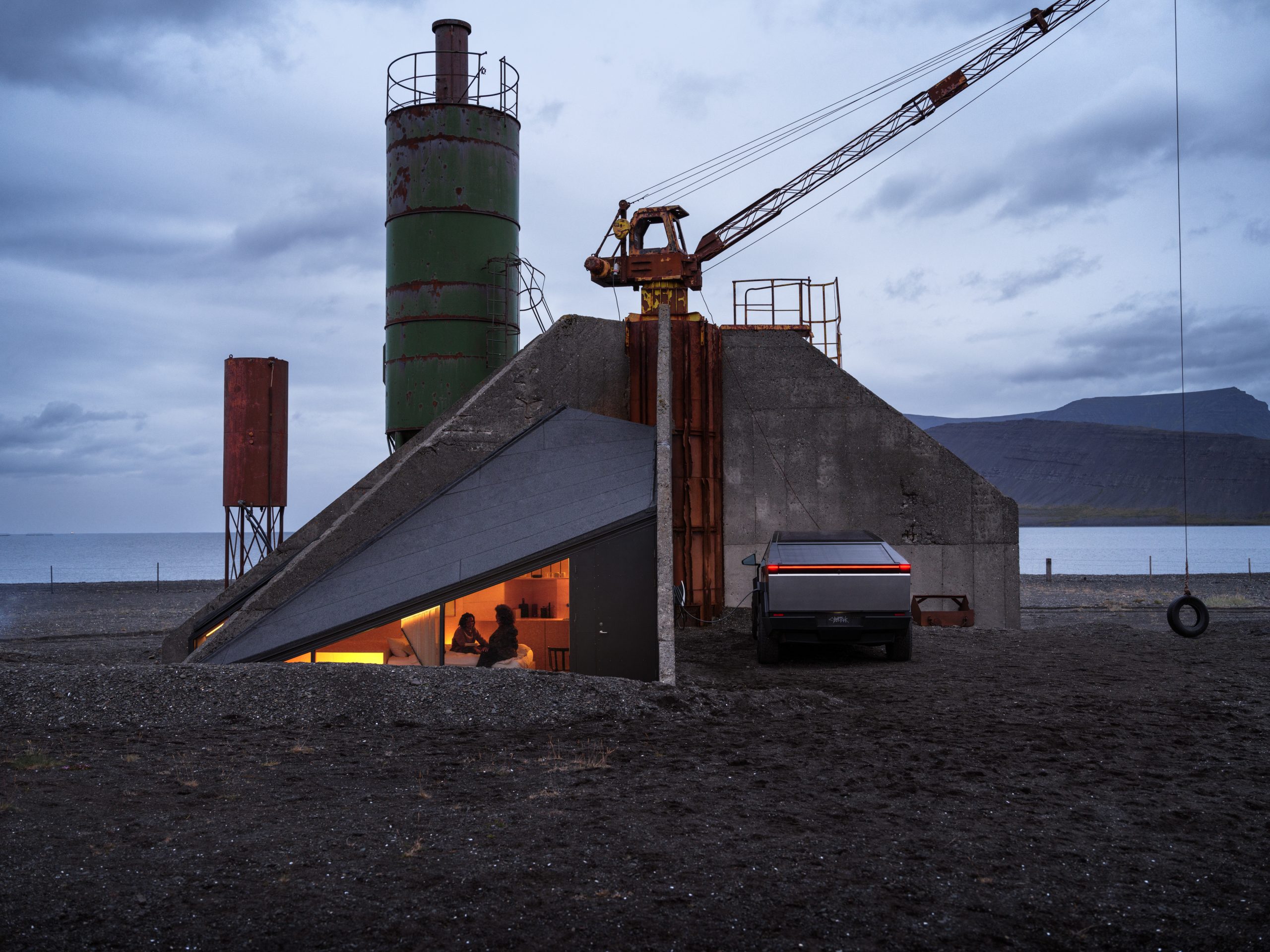
Tesla is updating Cybertruck owners on its timeline of a massive feature that has yet to ship: Powershare with Powerwall.
Powershare is a bidirectional charging feature exclusive to Cybertruck, which allows the vehicle’s battery to act as a portable power source for homes, appliances, tools, other EVs, and more. It was announced in late 2023 as part of Tesla’s push into vehicle-to-everything energy sharing, and acting as a giant portable charger is the main advantage, as it can provide backup power during outages.
Cybertruck’s Powershare system supports both vehicle-to-load (V2L) and vehicle-to-home (V2H), making it flexible and well-rounded for a variety of applications.
However, even though the feature was promised with Cybertruck, it has yet to be shipped to vehicles. Tesla communicated with owners through email recently regarding Powershare with Powerwall, which essentially has the pickup act as an extended battery.
Powerwall discharge would be prioritized before tapping into the truck’s larger pack.
However, Tesla is still working on getting the feature out to owners, an email said:
“We’re writing to let you know that the Powershare with Powerwall feature is still in development and is now scheduled for release in mid-2026.
This new release date gives us additional time to design and test this feature, ensuring its ability to communicate and optimize energy sharing between your vehicle and many configurations and generations of Powerwall. We are also using this time to develop additional Powershare features that will help us continue to accelerate the world’s transition to sustainable energy.”
Owners have expressed some real disappointment in Tesla’s continuous delays in releasing the feature, as it was expected to be released by late 2024, but now has been pushed back several times to mid-2026, according to the email.
Foundation Series Cybertruck buyers paid extra, expecting the feature to be rolled out with their vehicle upon pickup.
Cybertruck’s Lead Engineer, Wes Morrill, even commented on the holdup:
As a Cybertruck owner who also has Powerwall, I empathize with the disappointed comments.
To their credit, the team has delivered powershare functionality to Cybertruck customers who otherwise have no backup with development of the powershare gateway. As well as those with solar…
— Wes (@wmorrill3) December 12, 2025
He said that “it turned out to be much harder than anticipated to make powershare work seamlessly with existing Powerwalls through existing wall connectors. Two grid-forming devices need to negotiate who will form and who will follow, depending on the state of charge of each, and they need to do this without a network and through multiple generations of hardware, and test and validate this process through rigorous certifications to ensure grid safety.”
It’s nice to see the transparency, but it is justified for some Cybertruck owners to feel like they’ve been bait-and-switched.
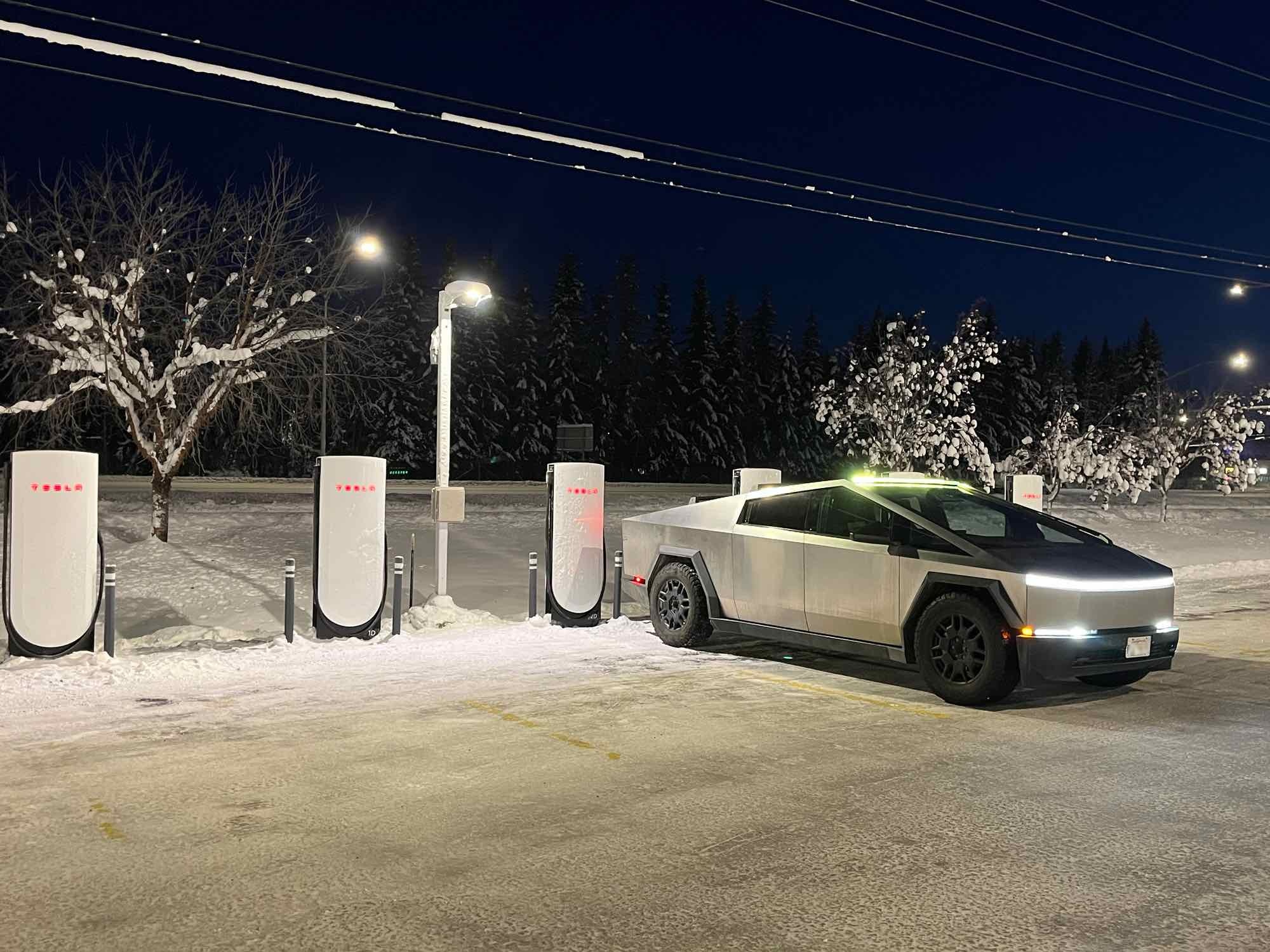
Tesla has opened its northernmost Supercharger in Fairbanks, Alaska, with eight V4 stalls located in one of the most frigid cities in the U.S.
Located just 196 miles from the Arctic Circle, Fairbanks’s average temperature for the week was around -12 degrees Fahrenheit. However, there are plenty of Tesla owners in Alaska who have been waiting for more charging options out in public.
There are only 36 total Supercharger stalls in Alaska, despite being the largest state in the U.S.
Eight Superchargers were added to Fairbanks, which will eventually be a 48-stall station. Tesla announced its activation today:
North America’s northernmost Supercharger Fairbanks, AK (8 stalls) opened to public. https://t.co/M4l04DZ6B5 pic.twitter.com/zyL6bDuA93
— Tesla Charging (@TeslaCharging) December 12, 2025
The base price per kWh is $0.43 at the Fairbanks Supercharger. Thanks to its V4 capabilities, it can charge at speeds up to 325 kW.
Despite being the northernmost Supercharger in North America, it is not even in the Top 5 northernmost Superchargers globally, because Alaska is south of Norway. The northernmost Supercharger is in Honningsvåg, Norway. All of the Top 5 are in the Scandanavian country.
Tesla’s Supercharger expansion in 2025 has been impressive, and although it experienced some early-quarter slowdowns due to V3-to-V4 hardware transitions, it has been the company’s strongest year for deployments.
🚨🚨 Tesla Supercharging had a HUGE year, and they deserve to be recognized.
🍔 Opened Tesla Diner, a drive-in movie theater with awesome, Chef-curated cuisine
🔌 Gave access to Superchargers to several EV makers, including Hyundai, Genesis, Mercedes-Benz, Kia, Lucid, Toyota,… pic.twitter.com/yYT2QEbqoW
— TESLARATI (@Teslarati) December 10, 2025
Through the three quarters of 2025, the company has added 7,753 stations and 73,817 stalls across the world, a 16 percent increase in stations and an 18 percent increase in stalls compared to last year.
Tesla is on track to add over 12,000 stalls for the full year, achieving an average of one new stall every hour, an impressive statistic.
Recently, the company wrapped up construction at its Supercharger Oasis in Lost Hills, California, a 168-stall Supercharger that Tesla Solar Panels completely power. It is the largest Supercharger in the world.
News
Tesla shocks with latest Robotaxi testing move
Why Tesla has chosen to use a couple of Model S units must have a reason; the company is calculated in its engineering and data collection efforts, so this is definitely more than “we just felt like giving our drivers a change of scenery.”

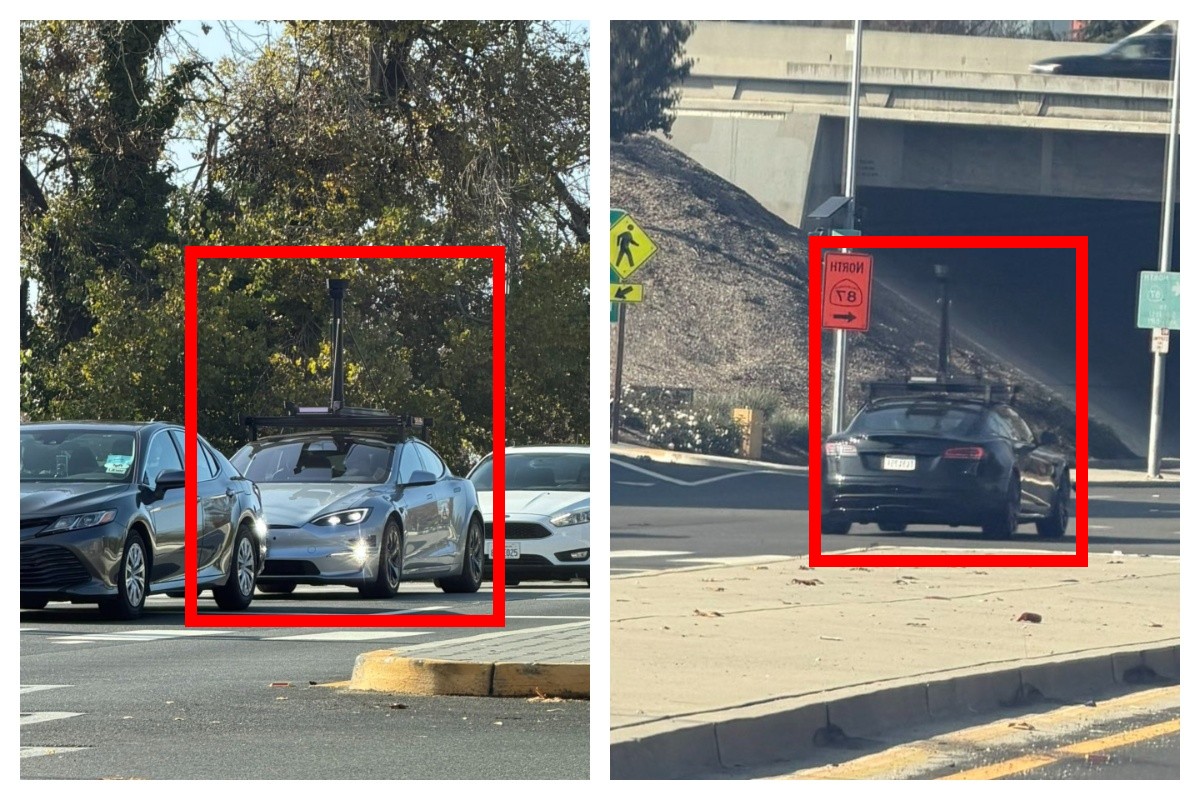
Tesla Model S vehicles were spotted performing validation testing with LiDAR rigs in California today, a pretty big switch-up compared to what we are used to seeing on the roads.
Tesla utilizes the Model Y crossover for its Robotaxi fleet. It is adequately sized, the most popular vehicle in its lineup, and is suitable for a wide variety of applications. It provides enough luxury for a single rider, but enough room for several passengers, if needed.
However, the testing has seemingly expanded to one of Tesla’s premium flagship offerings, as the Model S was spotted with the validation equipment that is seen entirely with Model Y vehicles. We have written several articles on Robotaxi testing mules being spotted across the United States, but this is a first:
🚨 Tesla is using Model S vehicles fitted with LiDAR rigs to validate FSD and Robotaxi, differing from the Model Ys that it uses typically
Those Model Y vehicles have been on the East Coast for some time. These Model S cars were spotted in California https://t.co/CN9Bw5Wma8 pic.twitter.com/UE55hx5mdd
— TESLARATI (@Teslarati) December 11, 2025
Why Tesla has chosen to use a couple of Model S units must have a reason; the company is calculated in its engineering and data collection efforts, so this is definitely more than “we just felt like giving our drivers a change of scenery.”
It seems to hint that Tesla could add a premium, more luxury offering to its Robotaxi platform eventually. Think about it: Uber has Uber Black, Lyft has Lyft Black. These vehicles and services are associated with a more premium cost as they combine luxury models with more catered transportation options.
Tesla could be testing the waters here, and it could be thinking of adding the Model S to its fleet of ride-hailing vehicles.
Reluctant to remove the Model S from its production plans completely despite its low volume contributions to the overall mission of transitioning the world to sustainable energy, the flagship sedan has always meant something. CEO Elon Musk referred to it, along with its sibling Model X, as continuing on production lines due to “sentimental reasons.”
However, its purpose might have been expanded to justify keeping it around, and why not? It is a cozy, premium offering, and it would be great for those who want a little more luxury and are willing to pay a few extra dollars.
Of course, none of this is even close to confirmed. However, it is reasonable to speculate that the Model S could be a potential addition to the Robotaxi fleet. It’s capable of all the same things the Model Y is, but with more luxuriousness, and it could be the perfect addition to the futuristic fleet.

Tesla updates Cybertruck owners about key Powershare feature

Tesla’s northernmost Supercharger in North America opens


