Lifestyle
A Tesla is greener than you think and getting greener – a look at manufacturing

An electric vehicle is more than just a new form of technology. It’s part of a shift in our entire way of life. From a consumables based civilization to a renewable one. My last article focused on the environmental benefits of driving an electric vehicle, but what about manufacturing? Is it also sustainable?
One of the main themes from my previous article is that the data surrounding electric vehicles has been quickly changing. Our electricity grid is getting greener, batteries are increasing in energy density, and costs are falling. This rapid advancement is the reason for many misconceptions about electric vehicles and it holds true of manufacturing as well. This article dives into the manufacturing impact, to give you a better feel for its significance, and show how much better it can get.
First though I want to be clear, an electric vehicle is without a doubt the better environmental choice. To get a good snapshot of this just take a look at the lifecycle greenhouse gas emissions in the graph below. These emissions include everything from raw material extraction, to vehicle manufacturing, through operation, and finally to end of life. It’s clear that the reductions from driving far exceed any emissions from vehicle production. The savings are huge.
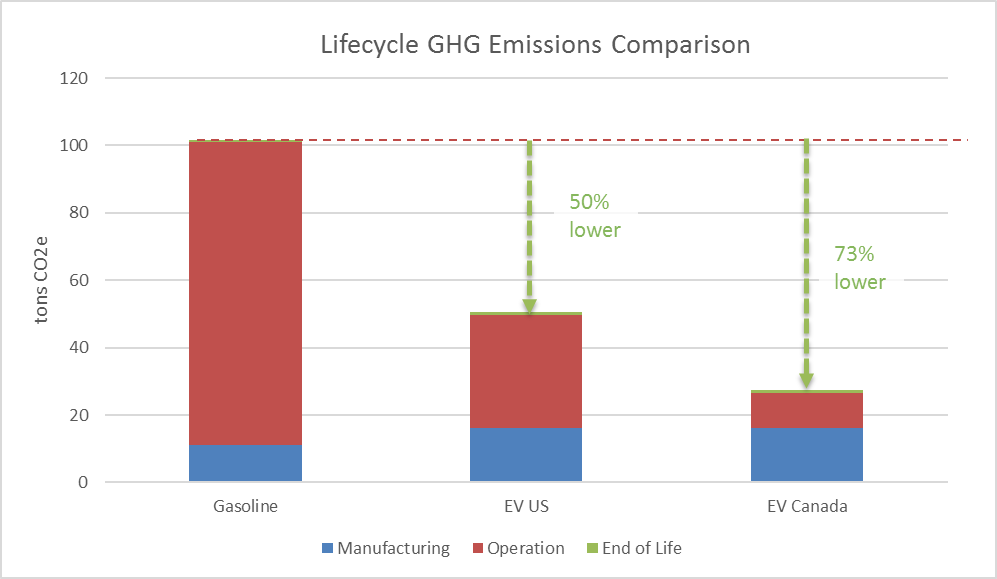
*Based on 180,000 miles of lifetime driving of a large electric sedan (85kWh), batteries manufactured in China, vehicles made in Germany or USA, IPCC median data of lifecycle emissions factors for electricity sources, 2016 electricity source mix from Canada and the USA for EV charging, and EPA data for a 26 mpg vehicle.
But what is the manufacturing based on you say? A fair question. Manufacturing emissions depend on many factors like: which materials are used, the source of those materials, technologies incorporated into the manufacturing processes, material transportation needs, and the type of energy used at each stage of production. The manufacturing data in the graph above is based on batteries produced on a carbon intensive grid (like China) with final vehicle assembly in Germany or the US. For a large 85kWh Tesla battery weighing around 550 kg, the battery would account for 6 tons of greenhouse gas emissions. I’ve seen this as the typical scenario in many research papers but with electricity grids getting cleaner every year the data quickly falls out of date. Still, it serves as a good baseline scenario. You may have seen higher numbers reported elsewhere, but frankly they are based on old data and often use the poor metric of kgCO2e/kWh, which doesn’t hold true as energy density rapidly improves. A better metric is kgCO2e/kg of battery but even that must be continually updated.
What may not be immediately clear from the graph, is that the savings from driving an electric vehicle will very quickly payback the emissions from manufacturing the entire vehicle. In Canada the payback would occur after about 55,000 kms, and the USA at 77,000 kms. So, if you’re already driving, the most environmentally friendly thing you can do is replace your combustion vehicle with an electric vehicle today!
That’s great…..but can we do better?
Remember that the blue bar in the graph assumes batteries are made in China and the vehicles are made in Germany or the USA. Not exactly low carbon electricity grids. It’s also based on studies using electricity data already a few years old and doesn’t account for the specific manufacturing facilities that are already better than the average electricity grids in those countries. Many manufacturers have also incorporated on site renewable energy and better recycling practices.
Manufacturer Highlights
- Tesla currently manufacturers vehicles in California and batteries in Nevada. The Nevada battery Gigafactory will be 100% renewably powered with a 70MW solar array and have on site recycling. The Freemont California grid is actually already very clean with 70% from non-fossil fuels (which partially explains the lack of solar there).
- Chevy’s Bolt is manufactured by GM in Michigan. 54% of the facility’s energy comes from a combination of a 350kW solar array and landfill gas. The batteries are made by LG batteries in Holland Michigan, predominately powered by a natural gas power plant. There is no solar integration in that LG facility but satellite imagery appears to show solar installed on some of their international facilities (oddly this is not mentioned in their sustainability reports). GM also has a plan to use 100% renewable energy by 2050 but that’s almost meaningless because almost everything should be 100% renewably powered by then or we’re going to be in big trouble.
- The Ford Focus EV is also made in Michigan factory which incorporates a 500kW solar array. Their batteries are also made by LG.
- Nissan has a solar array on the Leaf factory in Japan, but they don’t have one on the USA factory. Their batteries are also made by LG.
That’s a good look at today but manufacturers will continue to improve. In fact that’s a recurring theme in all my research, that what was true 5 years ago for electric vehicles is not the reality today and that in turn won’t be representative of the future. Electricity is getting cleaner, cars are getting lighter, recycling is improving, and batteries are becoming more energy dense. All of this makes manufacturing an EV more sustainable. The big question is how quickly and how much can they improve?
There are a variety of papers published on how individual factors can benefit the sustainability of electric vehicle manufacturing. What I’ve done is combine the impacts, as graphed below. The key takeaway from the graph is that Tesla, and possible others, are making EVs with low embodied manufacturing emissions and that this will only improve as time goes on.
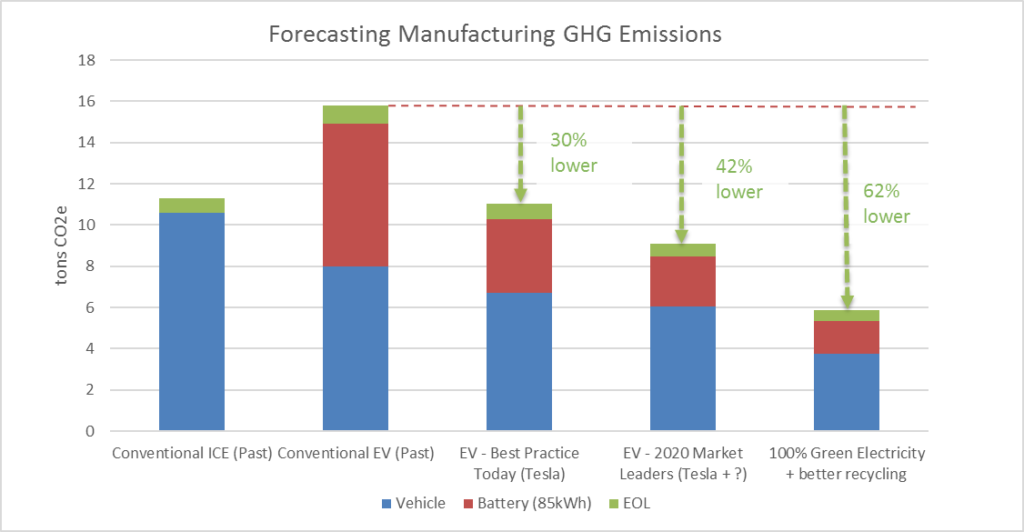
The graph compares the emissions from conventional manufacturing practices for a large combustion sedan and a large EV sedan, and then compares that to sustainability leaders like Tesla today, in 2020, and then into the future. Please remember this is representative data based on many research reports, manufacturing practices, battery density forecasts, some estimations of future conditions, and some interpolation of data.
How are these results achieved?
1: Selecting Clean Electricity Sources
Electricity is used extensively to produce both the materials used in vehicles and the assembled vehicles themselves, but there’s a huge variation in how ‘clean’ electricity grids are. China, Germany, and Michigan, are all locations big on vehicle manufacturing. China also has a huge chunk of the world’s battery production and will continue to do so. By 2020, worldwide production capacity is expected to expand five-fold, with China and South Korea producing 75% of world’s batteries.
In China coal use is down but still accounts for over 60% of electricity production, while in the USA it’s been dropping even faster, now at 30%. Germany, South Korea, and Michigan still get about 40% of their electricity from coal. Coal is a dirty fuel and manufacturers should avoid it to improve their sustainability. Then there’s the issue of climate change, driven by greenhouse gas emissions. Even though natural gas is cleaner to burn than coal, it still creates a lot of greenhouse gas and is responsible for significant methane leaks. For comparison purposes I’ve graphed the greenhouse gas emissions factors for relevant electricity grids and highlighted some specific manufacturer information to account for on-site renewable energy. It makes for an interesting comparison, showing that both the Chevy Bolt and Tesla facilities use electricity sources far greener than even their state grids.
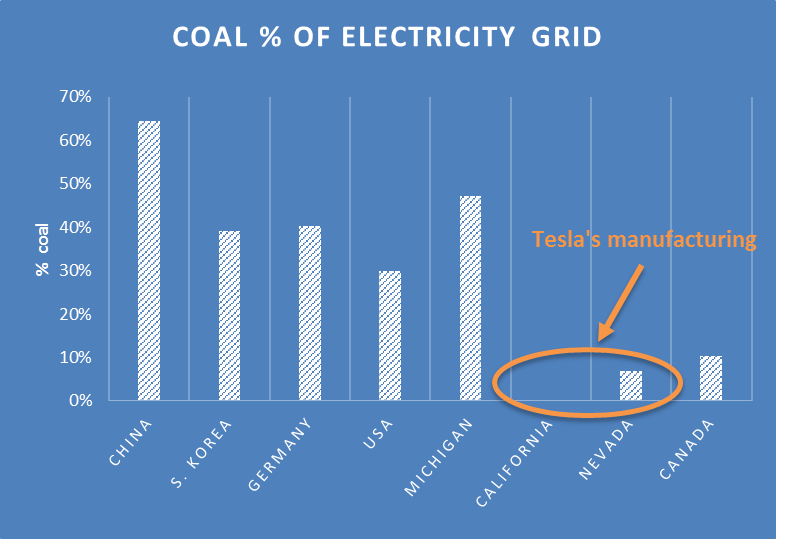
Why is coal considered dirty? Consider that natural gas produces approximately 50% less GHG emissions than coal, 99% less SOx, 90% less NOx, and 99% less particulates.
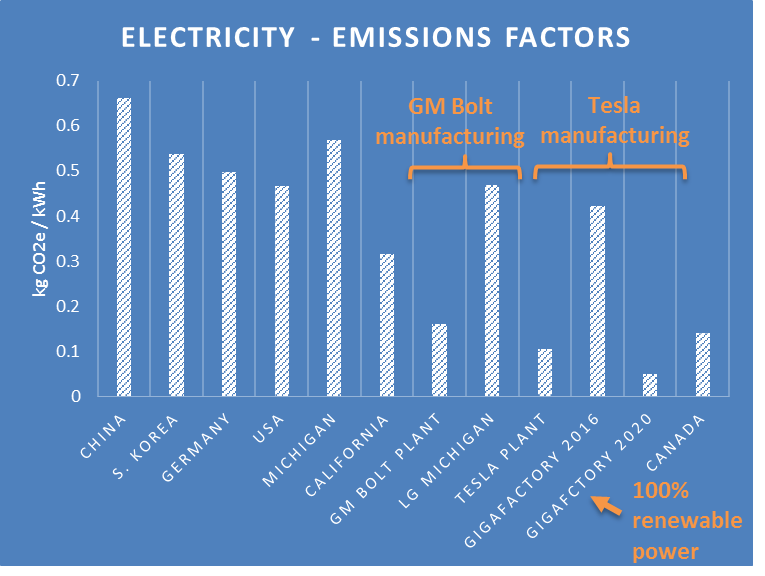
Data uses IPCC median emissions factors for electricity sources, not emission data from the individual plants or regions. It’s important to recognize that many of the components are not made by GM or Tesla at the facilities noted (i.e. airbags, engine blocks, etc). Electricity contributes 29% of the greenhouse gas emissions in the USA and industry is responsible for 21%. That means there’s a lot of room for manufacturing to go green with low-carbon electricity.
Look at the Gigafactory in 2020, what a difference a green electron makes! A recent study from the Norwegian University of Science and Technology found that using renewable electricity could drop production emissions by more than half. That’s for an entire Tesla Model S sized vehicle. With Tesla on the verge of expanding their manufacturing into China, it would be both surprising and disappointing if they didn’t make all new factories 100% renewably powered. It is the new benchmark that they themselves have set for sustainable manufacturing.
2: Light-weighting
You may have noticed a lot of manufacturers using more aluminum in their vehicles. There’s good reason for this. An aluminum body can be 40% lighter than a steel body, according to Audi, and Tesla’s Model S and X use aluminum exclusively in their construction. The push for longer range EVs is resulting in a push for lighter weight vehicles that use less materials. That’s great for the environment.
3: Longer Lasting Cars and Materials
Electric vehicles will last longer than conventional combustion cars today. Aluminum doesn’t rust, electric cars have far fewer moving parts to wear out and few disposable fluids to maintain, and the vehicles get over-the-air updates. But eventually they will wear-out, and this is where recycling comes in.
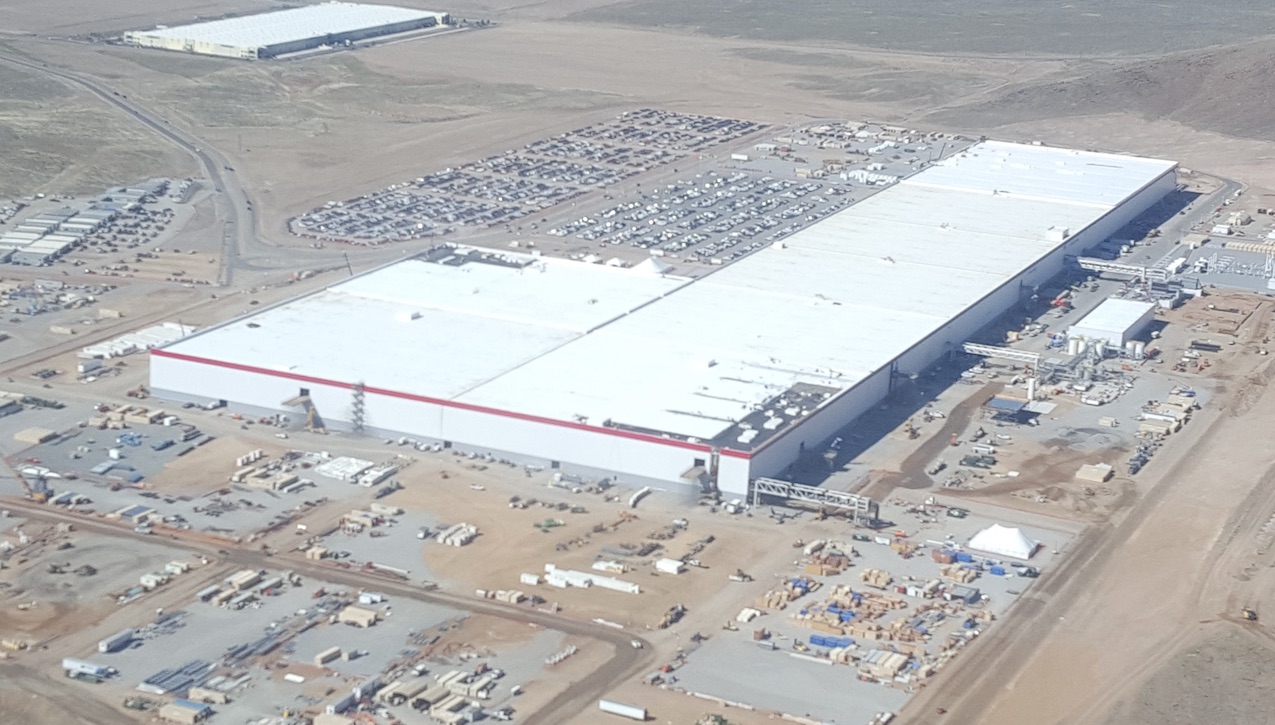
Tesla Gigafactory flyover March, 2017 [Source: NMGroup]
4: Recycling
Today material recovery rates for steel and aluminum in vehicles are very high, at about 90%. For aluminum this is a big deal because recycled aluminum uses only 5% of the electricity for processing, compared to processing from raw materials. I reached out to Tesla to get information on how much recycled content they use and where their aluminum comes from but they’ve yet to get back to me.
Batteries also benefit from recycling as they are composed mostly of valuable metals like aluminum, copper, nickel, cobalt, and lithium (there’s also the graphite anode to consider). Studies indicate a possible 50% reduction in total battery emissions from recycling. Tesla’s current battery recycler in Europe, Umicore, states that through their recycling they can already recover 70% of the GHG emissions that were produced during the original material extraction and refining stages. Large scale lithium-ion battery recycling won’t be needed for several years. Batteries today are expected to last a decade or more and that is continually improving. Just recently Tesla’s battery research division achieved a doubling of battery lifespans for NMC batteries used in their energy storage (their cars use the NCA chemistry). That was just one year into their work.
Imagine a vehicle that was produced entirely from recycled materials using 100% renewable energy, powered by renewable energy, driving quietly down the road with zero pollution. That’s the future. A truly closed loop, because once the materials are extracted, they can be used again and again. It’s not like gasoline which is used only once.
5: Ethical and local sourcing
The results discussed so far have included the emissions from extracting and processing materials, but what about the ethical and moral considerations? Ensuring that vehicles are produced ethically should be required of every manufacturer. Most of the manufacturers have ethical material sourcing reports, to varying degrees of diligence, and some is mandated of publicly traded companies. Tesla has also reaffirmed their commitment to ethically and locally sourced materials, on a number of occasions.
“Imagine a vehicle that was produced entirely from recycled materials using 100% renewable energy, powered by renewable energy, driving quietly down the road with zero pollution. That’s the future.”
Cobalt and graphite are potentially two of the biggest issues right now. Today 65% of the world’s cobalt comes from the Democratic Republic of Congo and most of the flake natural graphite is coming from China. Using less of these contentious materials is a good place to start. The NCA battery chemistry used by Tesla/Panasonic requires far less cobalt than the NMC chemistry commonly used by other manufacturers. They have also committed to sourcing cobalt from non-conflict zones. Canada seems to have a role to play here. Canada sits third in world production of cobalt and third in nickel production. It’s not a coincidence as cobalt is often the byproduct of nickel production. For graphite Tesla has previously stated that artificially produced graphite from Europe may be used and there are other anode materials in development.
Lithium is probably the most discussed material but accounts for ~10% of the battery by weight. It is overwhelmingly extracted from salt brines, pumped from under dried up salt flats in politically stable countries. It’s a pretty clean process but I do have issue with the evaporation process, as it depletes groundwater aquifers. Thankfully there are companies working to create new processes that don’t rely on evaporation to concentrate the minerals. But even with current methods, extracting a recyclable material like lithium has to be better than fracking for a consumable product like oil.
Conclusion:
Manufacturing electric vehicles today is comparable to or better than a combustion vehicle. This will only get better, especially if it’s something customers care about. It’s time to look beyond operational benefits and pay attention to which manufacturers are sustainability leaders. Vote with your dollars and call on manufacturers to make positive changes.
Tesla is undoubtedly one of the leaders. They are using clean electricity in their production today and their massive battery Gigafactory will be 100% renewably powered once complete. Their batteries have a low environmental impact relative to their peers due to the material composition, high energy densities, and clean electricity used in production. They are also have good recycling practices and will improve that with on-site battery recycling in the future. Their cars are long lasting, made of lightweight materials, and they have a good material sourcing strategy. If they can continue to be leaders in this way and push the industry forward, it may just transform all of manufacturing. That’s not to say Tesla is the only one. There are other manufacturers doing some of these good things, but no one seems to be as thorough or have the complete vision of the best possible future like Tesla does. But hey, if those other manufacturers can prove me wrong, all the better.


Elon Musk
How to use Grok Bot to block spam calls and texts
Musk told users to ask Grok Bot to scrub their phone numbers from spam lists.

Elon Musk has a new use case for Grok Bot, and it is the spam call. On Thursday he replied to an X user named Arash with a short instruction: “Ask your @Grok @Bot to remove your phone number from spam call & text lists!” Arash had said he got tired of the calls, had an AI bot find his number on listing sites and file removal requests, and packaged the process as a free skill for others.
The skill is called Spam-Call Scrubber, which is described to find a phone number on people search sites and data brokers, submits the opt outs, completes the confirmation emails those sites send back, and rechecks on a schedule the user picks. Using it requires the Grok Bot app. The pitch is time saved, since most broker opt outs sit behind separate forms on separate sites.
Ask your @Grok @Bot to remove your phone number from spam call & text lists!
— Elon Musk (@elonmusk) October 15, 2026
Musk said Grok Bot now gives each bot its own email address, and that it can detect scam emails. On Thursday he also said SpaceX would make users whole if the bot botches a purchase or leaks a card, then told users to shop away from Amazon after the retailer blocked the agent, as Teslarati reported. The terms of service we reviewed at the time put responsibility for what an agent does on the user.
For Tesla owners, Grok Bot is not just a phone app. Tesla brought Grok Bot into its vehicles on September 22, and we argued earlier this week that the Cybercab’s real advantage may be the errands it runs during a ride. Every Cybercab and the rest of the Model Y Robotaxi fleet has it enabled. The more routine tasks like this one become, the more a rider has reason to hand over something personal in the back seat.
The new Spam-Call Scrubber skill can be downloaded for free and works on sites that honor removal requests, while noting that listings can reappear, and illegal robocallers do not check any registry. Whether Spam-Call Scrubber cuts anyone’s call volume is something the first wave of users will find out, and Musk’s endorsement guarantees that wave is coming.
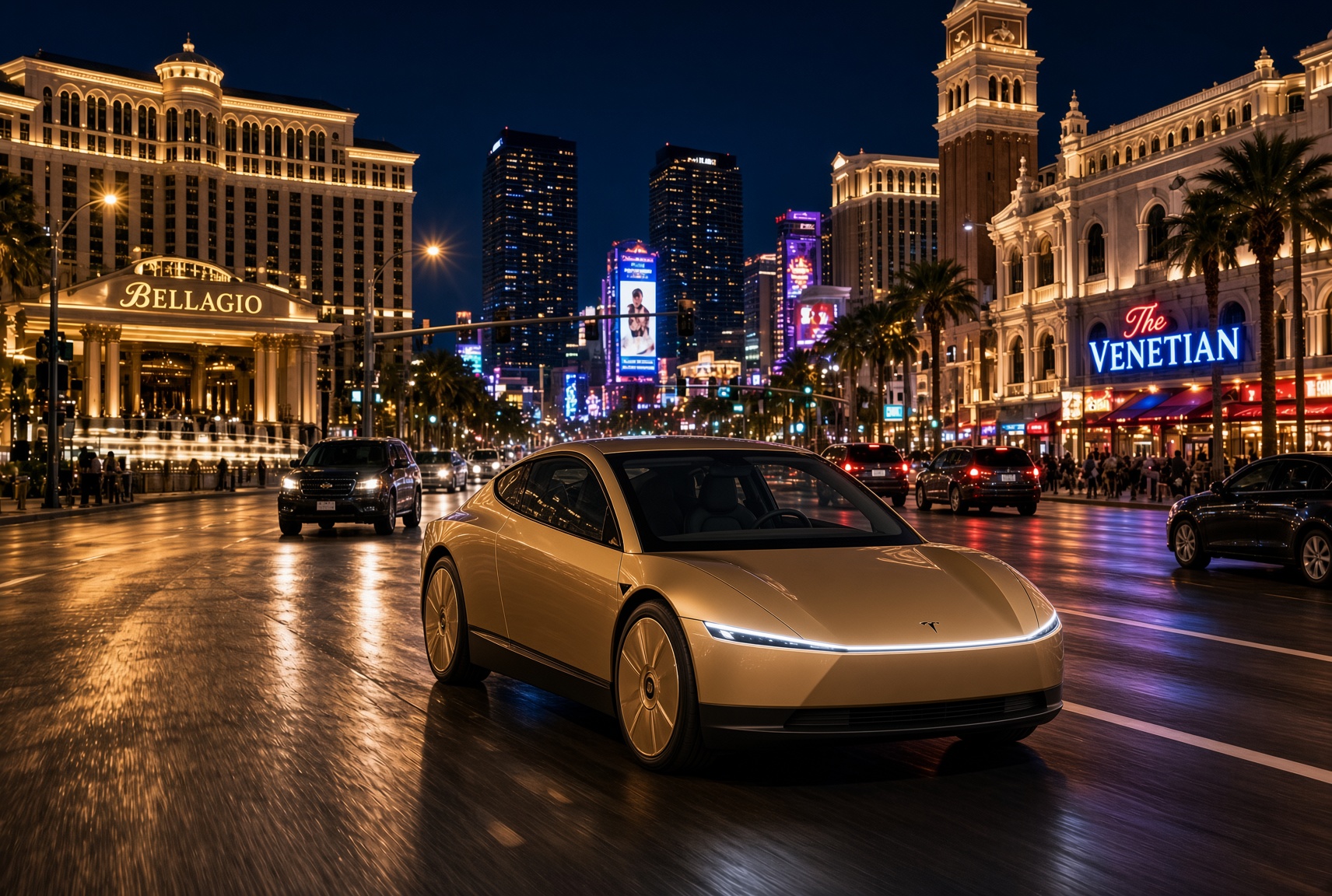
For a century, the car has asked the same thing of its owner, which is basically to pay attention. Even the best ride-hailing app like Uber or Lyft only moved the problem into someone else’s hands. You stopped driving, but you still sat in a stranger’s car, while half listening, and wondering whether to take a phone call in the car without being rude. The Cybercab has no wheel, no pedals and no driver. With Grok @bot now live inside it, it becomes something else entirely, and I think that matters more than the fleet count that everyone is tracking.
Grok @bot is an agent, not a voice assistant. A rider signs in once, and from then on can say what they need and watch it happen. Order dinner from a favorite restaurant. Fill the grocery cart. Move money, answer email, adjust a calendar, push a work project forward. Tesla engineer Yun-Ta Tsai confirmed it is enabled across every Cybercab and the rest of the Model Y fleet, and Tesla’s own pitch is that Full Self-Driving handles the commute while Grok handles the errands.
Think about what that does to a thirty minute ride. Uber sells you a trip, while Waymo sells you the same trip in a more private setting. Tesla is selling the thirty minutes themselves, returned to you with an assistant attached. Errands that used to eat a Saturday get done between pickup and drop off. The ride stops being dead time between two places and becomes a place of its own.
Tesla integrates Grok Bot into its vehicles for the ultimate personal assistant
Best of all, your Bots follow you into any Cybercab, and presumably your own Tesla, then logs you out automatically when you step out. Anyone can bolt a chatbot onto a screen, but much harder to own the vehicle, the autonomy stack and the assistant at once. It also quietly ties SpaceX’s Super Intelligence business to Tesla’s fleet, after Tesla converted its xAI stake into SpaceX equity. The relationship between those two companies is getting harder to describe as separate.
This is also where the hard questions start, because an agent that can spend your money in a vehicle other people also ride in needs some answers. How does it handle a voice it shouldn’t trust? What gets recorded, who can see it, and for how long? What happens when a rider leaves halfway through a task?
If Tesla gets those answers right, the scoreboard changes. We have been counting Cybercabs and wait times. The more telling number may be what riders accomplish per trip. That is data almost no one else will ever have, and it is the real reason to watch Grok @bot.
What do you think? Leave me a comment.
Lifestyle
Tesla’s mirrorless Cybercab will give riders a visibility upgrade
Tesla engineer confirms Cybercab update letting riders pull up rear and repeater cameras on demand.
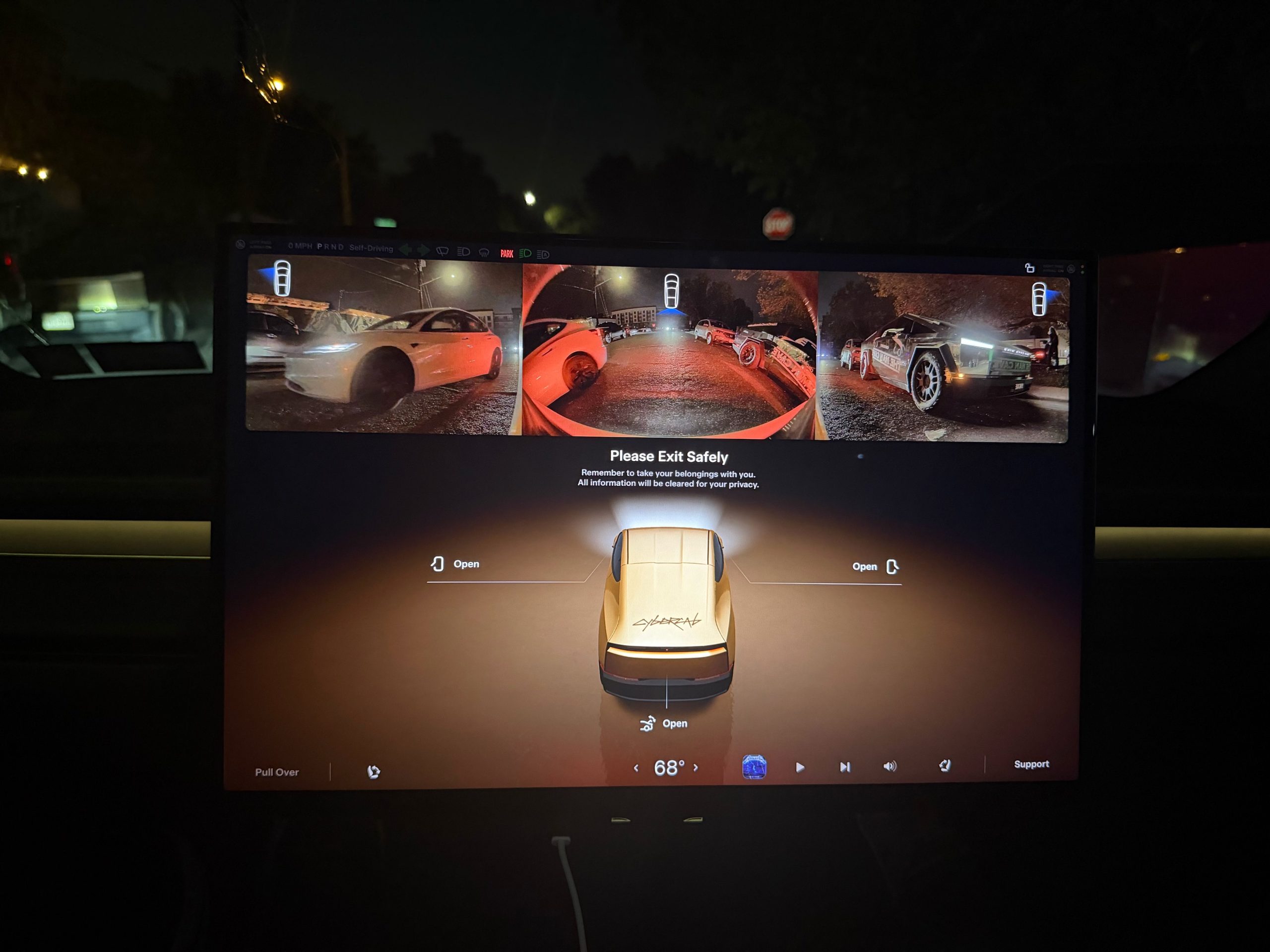
Tesla is working on a Cybercab update that would let passengers pull up the vehicle’s rear and side cameras on demand, and the request came straight from a rider.
The exchange played out on X late Friday. Cybercab rider Dan Burkland shared photos of the two-seater’s cabin screen after an evening ride, praised the UI team’s work, and left one request: let riders open the rear and repeater cameras whenever they want, “especially for peace of mind.” Tesla UI software engineer Evan (@CarCoder) answered with two words: “In development.”
The Tesla UI team absolutely crushed it with the infotainment software. Nicely done @CarCoder!
One feature request: Allow folks to pull up the rear & repeater cameras on demand. This would be great especially for peace of mind. https://t.co/mNAOSLx6pE
— Dan Burkland (@DBurkland) October 10, 2026
The idea fits a pattern Teslarati has tracked since public rides began. Days after paid Cybercab service opened in Austin, Tesla sent riders a survey that asked them to rate the touchscreen, the app and the cabin, and to pick the features they wanted most. We reported on that survey in September, and a camera view is the kind of small software change Tesla can push quickly if riders keep asking.
It also speaks to something unique about the vehicle. With no steering wheel, no pedals and no driver, passengers have no mirror to check and no way to see behind them. The hardware is clearly built for camera awareness, from the repeater cameras to the rear camera. Letting a passenger look through those same cameras would give a nervous first time rider a way to confirm what is around the car.
The timing matters because the fleet is growing fast. Tesla’s Robotaxi account said on Saturday that more than 300 Cybercabs are now serving Austin, an eightfold increase in 30 days, and Tesla AI chief Ashok Elluswamy named Dallas as the next city. More cars and more cities mean more people riding in a driverless vehicle for the first time, which is exactly when small trust features carry weight.
For now, the feature is confirmed only as in development. If Tesla follows its usual pattern with Cybercab software, riders could see it appear in a point release without any announcement, and Teslarati will watch for it.

Tesla shows what Roadster drivers will see on screen before thruster activation

Tesla reveals Optimus Academy, where robots teach themselves


